Low oil prices have fueled the debate about which industries Norway should develop and live on in the future. In the government’s revised national budget, the extraction of seabed minerals emerges as a clear investment area.
We all know what friction is — but it turns out to be very difficult to describe. Researchers have simplified a commonly used, century-old model for use at the nanoscale — by making it more complicated.
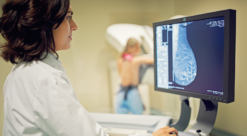
Imagine that we could instruct our bodies to make the drugs they need themselves. The gene technology that makes this possible is called mRNA therapy, which may become a major tool in the treatment of multiple diseases. Norwegian researchers are currently helping to develop a drug of this kind to treat the most aggressive form of breast cancer.
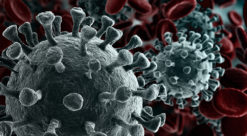
Testing families of four or more people would be an effective way to reduce the spread of the coronavirus infection, according to a data simulation model developed at NTNU. The model has initially been used to determine the best testing strategy for Oslo.
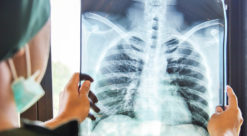
CT screening to detect lung cancer can save lives. The challenge is to find out who should undergo CT scans. A new method more accurately identifies the right individuals in the risk zone.
We are meeting as never before – online. Particularly in connection with our jobs this may present challenges, but it can also be very productive. Here is some advice from researchers for smart meetings in the virtual environment.
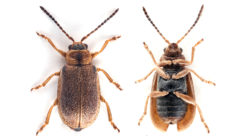
It took seven years, countless beetle penis field investigations, and hours upon hours on hands and knees in coastal wetlands. This is the story of all the research that has to happen before a new species can finally get its official name.
The stresses from home schooling, working at home and corona virus concerns are weighing us down on many levels. Here are some tips on ways to exercise at home that can help us maintain our health both physically and mentally.
A unanimous group of research scientists are convinced that kelp may share many of the applications of soya and oil, and that they can also be used to capture CO2. Seaweeds can contribute towards climate-friendly solutions in all sorts of contexts. New know-how about seaweed farming is currently accelerating industrialisation of the sector.
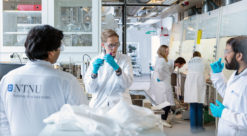
NTNU researchers recently figured out a whole new method for testing people for the coronavirus. The university is now producing tests on a continuous basis, under the auspices of the Norwegian Directorate of Health. Currently 100 000 tests a day are being manufactured, with production soon likely to be scaled up dramatically.
Researchers believe that plastic refuse can be used as fuel in cement factories in Asia. If this works, it may provide a solution to two of the planet’s biggest environmental problems – plastic in the oceans and high levels of coal consumption.
Newly developed technology has given robots the ability to learn new skills, enabling them to perform complex tasks and work alongside humans. This innovation can benefit many crucial societal functions, such as food production
Children’s health declines the longer they live in refugee camps. Many adults are also struggling, with seven out of ten feeling like they have no future.
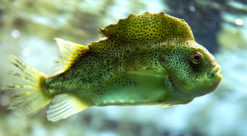
Research shows that even fish farmers have doubts as to whether using cleaner fish is an effective delousing method. “Fish farmers tell us that they want a ban on the use of certain species. They’re also very critical of wild-caught cleaner fish being transported,” says researcher Kristine Størkersen. She is one of the scientists who have been helping the Norwegian Food Safety Authority gain an overview of the situation.
Italy’s budget deficit is skyrocketing. Yet people there are not debating the cost of a human life, or whether the shutdown of the country is worth it.
Governments across the globe are funding record-breaking crisis packages to cope with the economic fallout from the coronavirus pandemic. Is this the time to fund greener, more climate-friendly industries and investments?
Now that “everybody” is working from home, it can be challenging for companies to recruit and onboard new employees. How can the new hires be productive and feel that they belong in the workplace when they are working from home? According to scientists, there are good guidelines for dealing with this and therefore no reason to delay action.
Droplets and bubbles are formed nearly everywhere, from boiling our morning coffee, to complex industrial processes and even volcanic eruptions. New research from SINTEF and NTNU in Norway, improves our understanding of how these bubbles and droplets form. This could improve our ability to model climate change.
NTNU in Gjøvik has developed a better design for face shields, which are part of the personal protection equipment used by medical professionals. Major production of the new shields – up to 250 per day – is starting on the university’s 3D printers this week.
The Privacy Statement is about how this website collects and uses visitor information. The statement contains information that you are entitled to when collecting information from our website, and general information about how we treat personal data.The legal owner of the website is the processing officer for the processing of personal data. It is voluntary for those who visit the web sites to provide personal information regarding services such as receiving newsletters and using the sharing and tip services. The treatment basis is the consent of the individual, unless otherwise specified.
1. Web analytics and cookies (cookies)
As an important part of the effort to create a user-friendly website, we look at the user pattern of those who visit the site. To analyze the information, we use the Google Analytics analysis tool.Google Analytics uses cookies (small text files that the site stores on the user's computer), which registers the users' IP address and provides information about the individual user's online movements. Examples of what the statistics give us answers to are; how many people visit different pages, how long the visit lasts, what websites users come from and what browsers are used. None of the cookies allow us to link information about your use of the site to you as an individual.The information collected by Google Analytics is stored on Google servers in the U.S.. The information received is subject to the Google Privacy Policy.An IP address is defined as a personal information because it can be traced back to a particular hardware and thus to an individual. We use Google Analytics's tracking code to anonymize the IP address before the information is stored and processed by Google. Thus, the stored IP address can not be used to identify the individual user.
2. Search
If the webpage has search function, it stores information about what keywords users use in Google Analytics. The purpose of the storage is to improve our information service. The search usage pattern is stored in aggregate form. Only the keyword is saved and they can not be linked to other information about the users, such as the IP addresses.
3. Share / Tips service
The "Share with others" feature can be used to forward links to the site by email, or to share the content of social networking. Tips for tips are not logged with us, but only used to add the tips to the community. However, we can not guarantee that the online community does not log this information. All such services should therefore be used wisely. If you use the email feature, we only use the provided email addresses to resend the message without any form of storage.
4. Newsletter
The website can send out newsletters by email if you have registered to receive this. In order for us to be able to send e-mail, you must register an e-mail address. Mailchimp is the data processor for the newsletter. The e-mail address is stored in a separate database, not shared with others and deleted when you unsubscribe. The e-mail address will also be deleted if we receive feedback that it is not active.
5. Registration, form
The website may have a form for registration, contact form or other form. These forms are available to the public to perform the tasks they are supposed to do.Registration form is for visitors to sign up or register.Contact form is for visitors to easily send a message to the website's contact person.We ask for the name of the sender and contact information for this. Personal information we receive is not used for purposes other than responding to the inquiry.The form is sent as email via Mailgun as a third party solution. The entire submission will be stored at Mailgun for 24 hours. Between 24 hours and 30 days, only mailheader is stored before the submission is deleted after 30 days. The reason for this storage is to confirm whether emails are sent from the website and forwarded to the correct recipient.Once the email is received by the recipient, it is up to the recipient to determine the data processing needs of the email.
6. Page and service functionality
Cookies are used in the operation and presentation of data from websites. Such cookies may contain language code information for languages selected by the user. There may be cookies with information supporting the load balancing of the system, ensuring all users the best possible experience. For services that require login or search, cookies can be used to ensure that the service presents data to the right recipient.