How terrorism affects our attitudes
Some types of terrorist acts affect people much more than others. Islamist violence apparently produces the strongest counter-reactions.


Some types of terrorist acts affect people much more than others. Islamist violence apparently produces the strongest counter-reactions.

What challenges do teens face when they prioritize both their education and elite sports? Researchers have interviewed athletes who juggle both.

Did you know that light is a factor that affects both learning and the psychological development in school children? The right kind of light can boost performance in reading, writing and maths, and suppress restlessness and aggression.

Norwegians are not necessarily being selfish by wanting to go back to the good old days of cheap electricity. Nor do people think it is acceptable to use the situation for some to enrich themselves at the expense of others, says the researcher.

Physically active people who increased their activity level early on in the pandemic had poorer mental health than those who delayed increasing their exercise.

In collaboration with SINTEF, the industrial company Removr aims to become a world leader in direct CO2 capture from air.
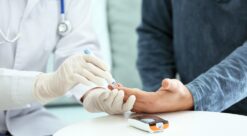
Not everyone with diabetes knows they have the disease. A survey of close to 53 000 participants found that far more people are being discovered with diabetes than was previously thought.

Bike-sharing is a way for cities to cut their greenhouse gas emissions while limiting urban congestion. But bikes have to be available when and where people want them. A new approach can help by ensuring bikes are in the right place at the right time.

The number of abuse cases against children via the internet has increased by almost 50 per cent in five years, according to the Norwegian Broadcasting Corporation. Researchers at NTNU in Gjøvik have developed algorithms that can help detect planned online grooming by analysing conversations.
Most people know that metals are made from ore, but how do we make gold from gravel? That’s the process we must understand to be able to make the metal industry climate friendly. Here are some alternatives for CO2-free metal production.

The interplay between mercury and manganese in Arctic seawater may explain a surprising drop researchers found in mercury levels in the Barents Sea during the winter.
It is difficult to recycle artificial turf and there are no obvious deposit-return systems for these plastics on the market. But researchers are now looking to find a solution to the problem.

Many countries have introduced market competition and privatization in their health care systems in recent years. But the most satisfied patients can be found in countries where a large part of the system is handled by the public sector.

Researchers had the crazy idea of feeding ragworms with locally-cultivated seaweeds. The results were as gold-edged as the worms themselves – a high-quality, locally-sourced and sustainable feed for farmed salmon.
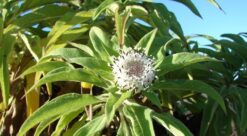
How animals and plants adapt to the environment is often particularly evident on islands. Now Darwin’s giant daisies are helping researchers understand a little more about how these plants actually go about adapting.
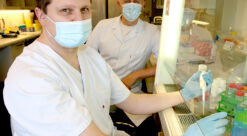
Just as with COVID-19, future viral outbreaks will have plenty of time to spread before a vaccine becomes available. A new approach developed at NTNU can save lives and prevent the need to shut down society.

Some children resort to food as a comfort or eat more for other reasons. But the link between predicted obesity-promoting eating behaviour and high BMI may not be what you think.

Combining ultrasound and bubbles helps medicines pass through the protective blood-brain barrier and is giving hope for improved treatment of several diseases.

A team of Norwegian researchers has succeeded in producing hydrogen using a far more efficient method than is currently in use. The technology was ready as early as in 2017. The team has also demonstrated that the process can be scaled up for commercial application.

Girls do not lose body fat from being more physically active. Nor is how round they are connected to how active they are. But researchers have found these links for boys.

The prevailing belief by researchers has been that mothers of twins are more fertile than other women. But a new study shows that isn’t the case.
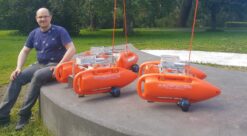
NTNU biology and cybernetics researchers have built a robot that allows them to sample everything from microplastic to salmon lice densities.
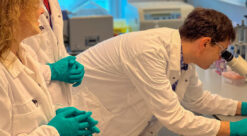
Researchers have discovered a new method of activating enzymes that may make it possible to repair proteins that have been damaged as a result of hereditary diseases, such as some types of skin cancer.
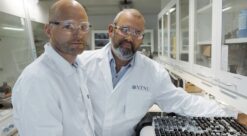
Researchers are creating molecules that can slow down the development of osteoporosis, cancer and inflammation. Foreign investors are interested.
Very soon, there will be enormous numbers of used EV batteries available, but we have yet to work out how we will be organising the reuse of this massive resource.
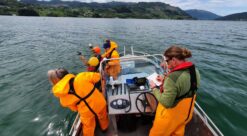
Researchers at NINA, the Norwegian Institute for Nature Research, and NTNU have developed a new method for monitoring salmon lice larvae along the coast. The lice trap is now being tested in the Hardangerfjord.
Show us your heat pump, and we’ll tell you if you’re using it right. Researchers provide advice that can save you both energy and money.
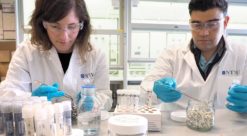
Chemists behave like detectives as they examine sludge from sewage systems. They hope to contribute to better sludge recycling by identifying the contaminants and toxic substances it contains.
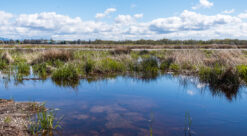
At the boundary between the land and sea, there exists an ecosystem that has been overlooked by Norwegians for so long that it was only recently given an official name. But studies are revealing that it has some very desirable properties.
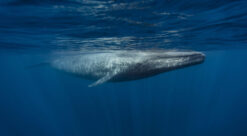
The Earth’s oceans are crisscrossed with roughly 1.2 million km of fibre optic telecommunication cables — enough to girdle the planet 30 times. Researchers have now succeeded in using fibre in a submarine cable as a passive listening system, enabling them to listen to and monitor whales.
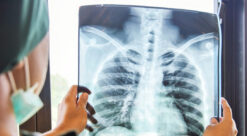
Lung cancer is one of the most dangerous forms of cancer. Treatments are available, but they are demanding on patients and less than 30 percent survive. But mRNA technology is offering new hope for higher survival rates because treatments target the malignant cells in an entirely new way.

In the age of smartphones and social media, the number of adolescents and young adults in Norway with depression and anxiety has doubled. Researchers believe politicians and technology giants need to take more responsibility.