
Could cusk fish be the new cod?
Today we think of cusk as a bycatch species of little or no value. But our test panel came to quite a different conclusion.

Today we think of cusk as a bycatch species of little or no value. But our test panel came to quite a different conclusion.
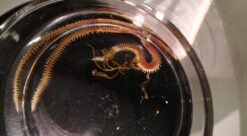
Researchers had the crazy idea of feeding ragworms with locally-cultivated seaweeds. The results were as gold-edged as the worms themselves – a high-quality, locally-sourced and sustainable feed for farmed salmon.
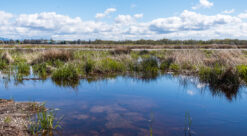
At the boundary between the land and sea, there exists an ecosystem that has been overlooked by Norwegians for so long that it was only recently given an official name. But studies are revealing that it has some very desirable properties.
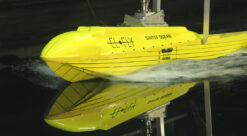
With this seaplane you will be able to take off from Trondheim Fjord or Flesland Airport in Bergen, Norway, and land in the Geiranger Fjord one hour later.
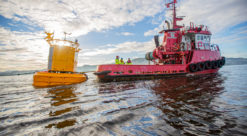
The OceanLab will contribute to research on underwater robotics, aquaculture, autonomous shipping and environmental research.

Relatively simple adaptation could make the cargo ships of the future completely green. The technology is based on the chemical compound ammonia, some extensive number crunching and one or two engine modifications.
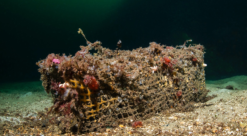
Ghost fishing and plastic waste from the fisheries industry is becoming a major environmental problem. Can we address the issue by using degradable plastics? Scientists at a new research centre are aiming to find the answers and develop the systems we need.

Intelligent food handling by robots can boost productivity and reduce waste in the production chain. Meet the robot with visual and tactile sensing, capable of handling compliant food objects.
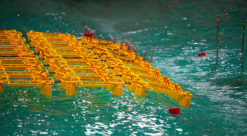
The sun shines just as much out at sea as it does on land. There are also no restrictions on area use and seawater even helps to cool the solar panel technology. It’s only a matter of time before the first floating solar energy farms are installed at sea.
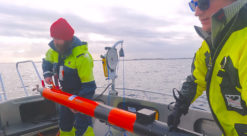
The microscopic, free-floating algae called phytoplankton — and the tiny zooplankton that eat them — are notoriously difficult to count. Researchers need to know how a warming climate will affect them both. A new kind of smart, lightweight autonomous underwater vehicle (LAUV) can help.
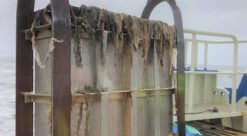
Research scientists in Norway recently set out on a scientific cruise in the Trondheim fjord to collect water samples and specimens of marine species. What they stumbled over was quite different from what they were looking for.
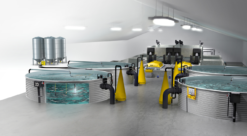
Land-based fish farming offers many benefits to both the fish and the environment. In traditional offshore farms, the fish are vulnerable to sea lice infestation and infectious diseases. Modern land-based aquaculture systems are able to offer local fish products in landlocked countries.
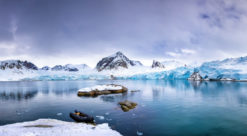
A team of researchers studying our footprint in the Arctic has taken samples of marine animals and wastewater linked to tourism. Their findings have revealed surprising levels of pharmaceutical drugs.

The feed cost represents about 50 percent of the costs of farming salmon. But how do we know if the salmon is hungry or still full? Researchers have rethought to find answers. The result is less wastage and pollution – and enough food for the salmon.
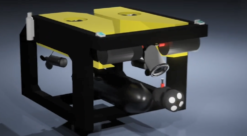
This ROV can fully operate on its own, and follow along with fish’s behaviour and health with its Argus eyes – all while keeping a safe distance. It even inspects the technical standard of the enclosure while it’s at it. Say hi to Mr. CageReporter.
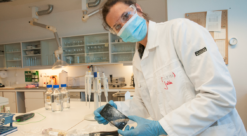
The Norwegian research organisation SINTEF will investigate whether rare earth element minerals contribute to pollution in costal areas. Research scientists from Norway, Denmark and Germany are taking part in the project.
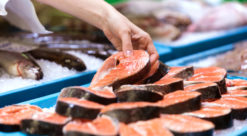
The rest raw materials left after a salmon has been filleted are equivalent to more than 60 percent of its slaughtered weight. It will soon be possible to convert these into a high-quality fish oil, taste-neutral fish proteins, fish gelatin and flame-retardant materials. Ensuring that not a single gramme goes to waste.

Tired of people claiming that the climate crisis isn’t real? You’re not the only one. This is why they are wrong.
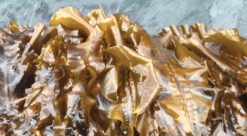
A unanimous group of research scientists are convinced that kelp may share many of the applications of soya and oil, and that they can also be used to capture CO2. Seaweeds can contribute towards climate-friendly solutions in all sorts of contexts. New know-how about seaweed farming is currently accelerating industrialisation of the sector.

Newly developed technology has given robots the ability to learn new skills, enabling them to perform complex tasks and work alongside humans. This innovation can benefit many crucial societal functions, such as food production
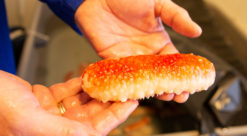
Sea cucumbers are internationally known as a superfood, as they contain many healthy substances. They are highly sought after by both Chinese restaurants and health food manufacturers. However, many sea cucumber species are threatened with extinction, so researchers want to farm them commercially – on land.