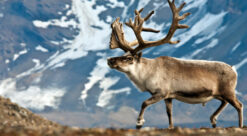
Despite inbreeding and limited genetic diversity, the Svalbard reindeer has managed to adapt to extreme living conditions in record time — what researchers call a genetic paradox. But can they survive climate change?
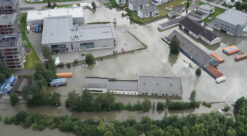
An extreme storm in Norway called Hans has accelerated the debate about how we should build and where we can live. Adapting to wilder and wetter weather also means that engineers are exposed to greater ethical pressure.
Researchers have developed a new method of detecting a metabolic disease that affects dairy cows after calving. The aim is to determine whether cows are at risk of contracting the disease before they actually become sick.
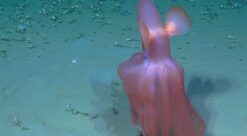
Arctic researchers have travelled north to study ice and life in the Arctic Ocean. They discovered a creature at a depth of 3500 metres, a “dumbo octopus” dancing in the deep waters in a ballerina’s skirt.
Increased cooperation between Norwegian industry and universities on quantum physics sensors is a win-win situation for society. Such sensors can provide new opportunities in areas as diverse as mineral extraction and agriculture.
The number of lemmings varies greatly from year to year. Other species also have similar fluctuations. Why is it like this, and what happens if lemming years happen less often?
Approximately 47 000 different species have been identified in Norway – and there are probably many more. A new tool can help us gain a better overview.
The plant is called common ragweed, and if you are allergic to pollen, you should probably pay extra close attention. This is one of the invasive plants that supergenes have brought to Norway.
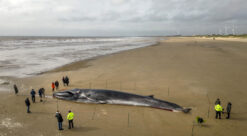
For the first time ever, researchers have been able to track eight fin whales in near real time for five hours, as they swam along a stretch of fibre-optic cable line in the Arctic. The breakthrough suggests that fibre-optic cable networks could be harnessed to help prevent whale deaths by ship strikes.
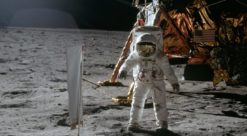
NASA has finished its planning and is ready to go. Humans will soon be returning to the Moon – this time in a manned base. But, if this project is to succeed, astronauts must be able to grow their own food. Norwegian researchers are in the process of making this possible.
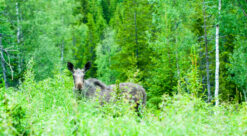
Climate researchers have long known that large animals, like moose, could play a role in how much the Earth will warm due to climate change. But the question is, how much? New research shows the answer can be a lot.
You don’t get to discover a new insects and arachnids numbering in the hundreds every day. Most of the new discoveries were of the biting midge variety.
By using a cutting edge technique to observe what’s happening at the atomic level inside their material, researchers at NTNU have discovered a surprising new method to make aluminium alloys stronger.
Even seemingly small changes in the climate can change the number of animals and plants in an area and how species behave, new research shows. Natural history collections provide valuable insights.
The Moon’s atmosphere is entirely devoid of oxygen. If humans want to stay there for extended periods, it will be of great benefit to make breathable oxygen there instead of having to transport it from Earth. But is this at all possible?
The Privacy Statement is about how this website collects and uses visitor information. The statement contains information that you are entitled to when collecting information from our website, and general information about how we treat personal data.The legal owner of the website is the processing officer for the processing of personal data. It is voluntary for those who visit the web sites to provide personal information regarding services such as receiving newsletters and using the sharing and tip services. The treatment basis is the consent of the individual, unless otherwise specified.
1. Web analytics and cookies (cookies)
As an important part of the effort to create a user-friendly website, we look at the user pattern of those who visit the site. To analyze the information, we use the Google Analytics analysis tool.Google Analytics uses cookies (small text files that the site stores on the user's computer), which registers the users' IP address and provides information about the individual user's online movements. Examples of what the statistics give us answers to are; how many people visit different pages, how long the visit lasts, what websites users come from and what browsers are used. None of the cookies allow us to link information about your use of the site to you as an individual.The information collected by Google Analytics is stored on Google servers in the U.S.. The information received is subject to the Google Privacy Policy.An IP address is defined as a personal information because it can be traced back to a particular hardware and thus to an individual. We use Google Analytics's tracking code to anonymize the IP address before the information is stored and processed by Google. Thus, the stored IP address can not be used to identify the individual user.
2. Search
If the webpage has search function, it stores information about what keywords users use in Google Analytics. The purpose of the storage is to improve our information service. The search usage pattern is stored in aggregate form. Only the keyword is saved and they can not be linked to other information about the users, such as the IP addresses.
3. Share / Tips service
The "Share with others" feature can be used to forward links to the site by email, or to share the content of social networking. Tips for tips are not logged with us, but only used to add the tips to the community. However, we can not guarantee that the online community does not log this information. All such services should therefore be used wisely. If you use the email feature, we only use the provided email addresses to resend the message without any form of storage.
4. Newsletter
The website can send out newsletters by email if you have registered to receive this. In order for us to be able to send e-mail, you must register an e-mail address. Mailchimp is the data processor for the newsletter. The e-mail address is stored in a separate database, not shared with others and deleted when you unsubscribe. The e-mail address will also be deleted if we receive feedback that it is not active.
5. Registration, form
The website may have a form for registration, contact form or other form. These forms are available to the public to perform the tasks they are supposed to do.Registration form is for visitors to sign up or register.Contact form is for visitors to easily send a message to the website's contact person.We ask for the name of the sender and contact information for this. Personal information we receive is not used for purposes other than responding to the inquiry.The form is sent as email via Mailgun as a third party solution. The entire submission will be stored at Mailgun for 24 hours. Between 24 hours and 30 days, only mailheader is stored before the submission is deleted after 30 days. The reason for this storage is to confirm whether emails are sent from the website and forwarded to the correct recipient.Once the email is received by the recipient, it is up to the recipient to determine the data processing needs of the email.
6. Page and service functionality
Cookies are used in the operation and presentation of data from websites. Such cookies may contain language code information for languages selected by the user. There may be cookies with information supporting the load balancing of the system, ensuring all users the best possible experience. For services that require login or search, cookies can be used to ensure that the service presents data to the right recipient.