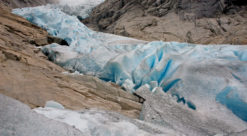
A new report from the Intergovernmental Panel on Climate Change (IPCC) describes with unnerving detail just what can happen if nations fail to limit greenhouse gas emissions. But rapid international action will keep the worst consequences at bay, the panel said.
An old building at Tullinløkka in Oslo has set a new standard for reuse, consisting of components from other buildings – like concrete floor dividers from a government building. Building stock in Norway accounts for half of society’s total environmental impact. Thinking in new ways and reusing building components offers multiple gains.
Large cost cuts are achievable for both floating and bottom-fixed wind farms in the future. If we do this correctly, floating wind turbines will be able to compete with bottom-fixed wind turbines by 2030.
France covered up the consequences of their nuclear tests in the Pacific. As many as 110 000 people may have been exposed to radioactive fallout above the assumed safe levels.
Much more research has been done on eating problems in girls than in boys. There are major differences between the genders when it comes to symptoms and bodies, and the same technique is not as suited to detecting problems in boys, says NTNU researcher Farzaneh Saeedzadeh Sardahaee.
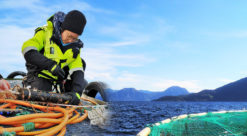
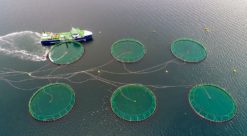
New technologies, including artificial intelligence, allow us to study salmon behaviour and their living environment in large-scale commercial sea cages.
Researcher Julia V. Bondeli studied corruption in Russia for five years. She was surprised at the scope of the problem. There are even “fixers” who are contracted to facilitate corrupt exchanges.
Dopamine is often called the “happy” or “feel-good” hormone. It can help explain both autistic behaviours and men’s need for passion in order to succeed.
The culprit behind a large number of cancerous tumours is known to be a certain protein. Now for the first time, research shows that the same protein is the cause of several rare brain syndromes.
Many of the world’s dams are not used for hydropower, but a new study shows they could be easily altered to produce renewable energy. This would be the most sustainable solution for new energy production in the world, says NTNU Professor Tor Haakon Bakken.
The higher parents’ education level, the more likely it is that their children will survive the first five years of life. Over three million births have been examined.
Most people obtain their information from multiple sources. Social media’s dreaded “echo chambers” have little significance for most of us, a new study shows.
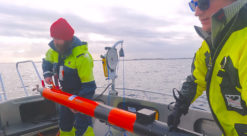
The microscopic, free-floating algae called phytoplankton — and the tiny zooplankton that eat them — are notoriously difficult to count. Researchers need to know how a warming climate will affect them both. A new kind of smart, lightweight autonomous underwater vehicle (LAUV) can help.
Researchers have studied the energy consumption of 140 hotels in Norway and Sweden. The use of CO2 heat pumps could cut energy consumption in these hotels by about 60 per cent.
If you’ve ever wondered about the importance of shipping and navigation, think back to the grounding of the Ever Given container ship in the Suez Canal in March this year. The ship, stuck fast for six days, crippled shipping worldwide at the costs of billions of US dollars. A new edition of a popular textbook looks at marine guidance, navigation and control.
NTNU has been selected by the European Commission to become partner to the New European Bauhaus initiative. “This will be an important and exciting partnership for us,” says Tor Grande, Pro-Rector for Research.
The Privacy Statement is about how this website collects and uses visitor information. The statement contains information that you are entitled to when collecting information from our website, and general information about how we treat personal data.The legal owner of the website is the processing officer for the processing of personal data. It is voluntary for those who visit the web sites to provide personal information regarding services such as receiving newsletters and using the sharing and tip services. The treatment basis is the consent of the individual, unless otherwise specified.
1. Web analytics and cookies (cookies)
As an important part of the effort to create a user-friendly website, we look at the user pattern of those who visit the site. To analyze the information, we use the Google Analytics analysis tool.Google Analytics uses cookies (small text files that the site stores on the user's computer), which registers the users' IP address and provides information about the individual user's online movements. Examples of what the statistics give us answers to are; how many people visit different pages, how long the visit lasts, what websites users come from and what browsers are used. None of the cookies allow us to link information about your use of the site to you as an individual.The information collected by Google Analytics is stored on Google servers in the U.S.. The information received is subject to the Google Privacy Policy.An IP address is defined as a personal information because it can be traced back to a particular hardware and thus to an individual. We use Google Analytics's tracking code to anonymize the IP address before the information is stored and processed by Google. Thus, the stored IP address can not be used to identify the individual user.
2. Search
If the webpage has search function, it stores information about what keywords users use in Google Analytics. The purpose of the storage is to improve our information service. The search usage pattern is stored in aggregate form. Only the keyword is saved and they can not be linked to other information about the users, such as the IP addresses.
3. Share / Tips service
The "Share with others" feature can be used to forward links to the site by email, or to share the content of social networking. Tips for tips are not logged with us, but only used to add the tips to the community. However, we can not guarantee that the online community does not log this information. All such services should therefore be used wisely. If you use the email feature, we only use the provided email addresses to resend the message without any form of storage.
4. Newsletter
The website can send out newsletters by email if you have registered to receive this. In order for us to be able to send e-mail, you must register an e-mail address. Mailchimp is the data processor for the newsletter. The e-mail address is stored in a separate database, not shared with others and deleted when you unsubscribe. The e-mail address will also be deleted if we receive feedback that it is not active.
5. Registration, form
The website may have a form for registration, contact form or other form. These forms are available to the public to perform the tasks they are supposed to do.Registration form is for visitors to sign up or register.Contact form is for visitors to easily send a message to the website's contact person.We ask for the name of the sender and contact information for this. Personal information we receive is not used for purposes other than responding to the inquiry.The form is sent as email via Mailgun as a third party solution. The entire submission will be stored at Mailgun for 24 hours. Between 24 hours and 30 days, only mailheader is stored before the submission is deleted after 30 days. The reason for this storage is to confirm whether emails are sent from the website and forwarded to the correct recipient.Once the email is received by the recipient, it is up to the recipient to determine the data processing needs of the email.
6. Page and service functionality
Cookies are used in the operation and presentation of data from websites. Such cookies may contain language code information for languages selected by the user. There may be cookies with information supporting the load balancing of the system, ensuring all users the best possible experience. For services that require login or search, cookies can be used to ensure that the service presents data to the right recipient.