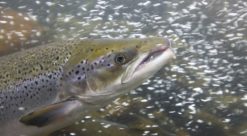
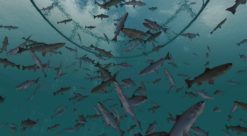
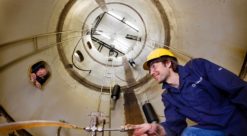
Fish farming is the largest source of phosphorus emissions in Norway, generating about 9,000 tonnes a year. Finding ways to reuse the waste from the fish farming industry could cut consumption of this important and increasingly scarce resource.
Researchers are using a high-precision instrument to inject toxins that alleviate migraine attacks. This means even better needle guidance and user-friendliness.
New research has revealed that Norwegian COPD sufferers are prescribed even more sedatives than psychiatric patients. The researchers behind the study believe that this is problematic because the drugs in question are addictive and inhibit lung function.
The British-born Pauline Braathen has given US $5 million to establish a new centre at the Kavli Institute for Systems Neuroscience at NTNU. The Kavli Foundation has matched this donation with NOK 50 million so that the new centre will receive a NOK 100 million grant.
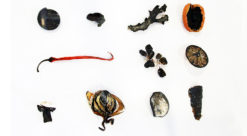
NTNU’s Gunnerus Library in Trondheim contains a number of manuscripts with unknown origins. Using modern technology, researchers aim to find some of these manuscripts’ secrets.
During thunderstorms, when Thor the God of Thunder starts wielding his hammer, researchers know exactly what you should and shouldn’t do if you want to keep safe.
A brand new study of 200 dementia sufferers in Norway reveals that almost all experience greater peace of mind and increased levels of physical activity using GPS devices.
NTNU researchers are delving deep to investigate the seabed and opportunities for deep sea mining to extract precious metals that lie several thousand metres deep.
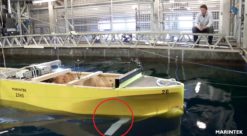
To you and me, this might look like a disaster. But Norwegian ski star Petter Northug’s car crash was actually pretty ideal. The materials in the car and guard rail acted just the way they were designed to in order to save the lives of passengers in the car.
You won’t see any paintings at the exhibition by the first International MFA graduates in Trondheim. But the exhibit offers a lot else, including food and healing.
From next summer cruise tourists taking excursions in Norway to sample Sami culture can look forward to an even more pleasant experience in the traditional ‘lavvo’ tents.
Oil droplets are providing clues about environmental impacts following oil discharges What really happens to the oil that ends up in the sea during a discharge, and how can we minimise the damage?
A new report reveals that 76 percent of children and adolescents who live in Norwegian child welfare institutions have serious psychiatric diagnoses. Only 38 percent report that they receive appropriate psychiatric help. One youngster was moved 25 times under the direction of Norway’s Child Welfare Services.
Three million egg-laying hens are destroyed each year. Researchers believe that this practice is inadequately sustainable and want to see the hens exploited for food, oils and proteins.
Substantial revenues from natural resources bring opportunities, but also problems, in developing countries. A new research project will look at best practices in resource management.
The health of people all over the world is dependent on a slew of different variables, so interdisciplinary work is vital to professionals in global health. Twenty-two European countries, the USA and South Africa are all taking part in a comprehensive Norwegian global health survey.
The Privacy Statement is about how this website collects and uses visitor information. The statement contains information that you are entitled to when collecting information from our website, and general information about how we treat personal data.The legal owner of the website is the processing officer for the processing of personal data. It is voluntary for those who visit the web sites to provide personal information regarding services such as receiving newsletters and using the sharing and tip services. The treatment basis is the consent of the individual, unless otherwise specified.
1. Web analytics and cookies (cookies)
As an important part of the effort to create a user-friendly website, we look at the user pattern of those who visit the site. To analyze the information, we use the Google Analytics analysis tool.Google Analytics uses cookies (small text files that the site stores on the user's computer), which registers the users' IP address and provides information about the individual user's online movements. Examples of what the statistics give us answers to are; how many people visit different pages, how long the visit lasts, what websites users come from and what browsers are used. None of the cookies allow us to link information about your use of the site to you as an individual.The information collected by Google Analytics is stored on Google servers in the U.S.. The information received is subject to the Google Privacy Policy.An IP address is defined as a personal information because it can be traced back to a particular hardware and thus to an individual. We use Google Analytics's tracking code to anonymize the IP address before the information is stored and processed by Google. Thus, the stored IP address can not be used to identify the individual user.
2. Search
If the webpage has search function, it stores information about what keywords users use in Google Analytics. The purpose of the storage is to improve our information service. The search usage pattern is stored in aggregate form. Only the keyword is saved and they can not be linked to other information about the users, such as the IP addresses.
3. Share / Tips service
The "Share with others" feature can be used to forward links to the site by email, or to share the content of social networking. Tips for tips are not logged with us, but only used to add the tips to the community. However, we can not guarantee that the online community does not log this information. All such services should therefore be used wisely. If you use the email feature, we only use the provided email addresses to resend the message without any form of storage.
4. Newsletter
The website can send out newsletters by email if you have registered to receive this. In order for us to be able to send e-mail, you must register an e-mail address. Mailchimp is the data processor for the newsletter. The e-mail address is stored in a separate database, not shared with others and deleted when you unsubscribe. The e-mail address will also be deleted if we receive feedback that it is not active.
5. Registration, form
The website may have a form for registration, contact form or other form. These forms are available to the public to perform the tasks they are supposed to do.Registration form is for visitors to sign up or register.Contact form is for visitors to easily send a message to the website's contact person.We ask for the name of the sender and contact information for this. Personal information we receive is not used for purposes other than responding to the inquiry.The form is sent as email via Mailgun as a third party solution. The entire submission will be stored at Mailgun for 24 hours. Between 24 hours and 30 days, only mailheader is stored before the submission is deleted after 30 days. The reason for this storage is to confirm whether emails are sent from the website and forwarded to the correct recipient.Once the email is received by the recipient, it is up to the recipient to determine the data processing needs of the email.
6. Page and service functionality
Cookies are used in the operation and presentation of data from websites. Such cookies may contain language code information for languages selected by the user. There may be cookies with information supporting the load balancing of the system, ensuring all users the best possible experience. For services that require login or search, cookies can be used to ensure that the service presents data to the right recipient.