Tailor-made for the aquaculture sector
Fish husbandry workers have played an active part in developing work clothing tailor-made for their wet, windy and messy working conditions.

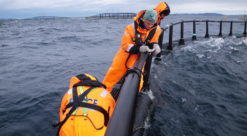
Fish husbandry workers have played an active part in developing work clothing tailor-made for their wet, windy and messy working conditions.
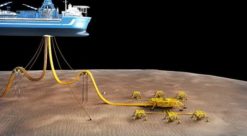
Oil companies are having problems finding out how much each of their wells is producing. Researchers believe this can be solved by providing each well with its own frequency.
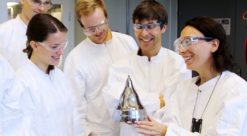
The solar cell industry is headed into clean-room labs to better understand and improve the materials that they are working with.
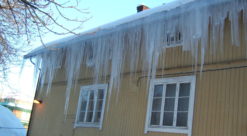
Every winter, many buildings collapse under the weight of snow. Climate change may result in more rain and greater volumes of snow, and many buildings have not been designed to cope with these conditions.
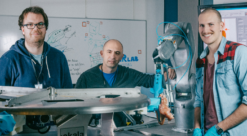
Can an industrial robot succeed both at removing the breast fillet from a chicken, and at the same time get more out of the raw materials? This is one of the questions to which researchers working on the CYCLE project now have the answer.
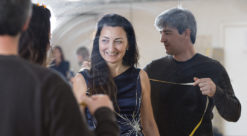
2014 NOBEL PRIZE: When May-Britt Moser accepts the Nobel Prize in Physiology or Medicine with her co-laureates Edvard Moser and John O’Keefe, she’ll be wearing a custom-made gala dress created by a designer who until a year ago was a tunnel engineer.
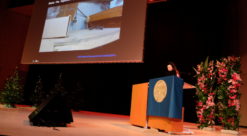
2014 NOBEL PRIZE: The brain has an enormous capacity to store memories and to keep memories from getting mixed up in part because of how these memories are stored in the hippocampus, researchers from NTNU’s Kavli Institute for Systems Neuroscience have shown.
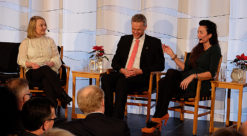
2014 NOBEL PRIZE: Teachers need to recognize students who burn with curiosity and cultivate that inquisitiveness, 2014 Nobel Laureates May-Britt and Edvard Moser said Monday in a special panel discussion on Science in Scandinavia organized by the Norwegian Embassy in Stockholm.
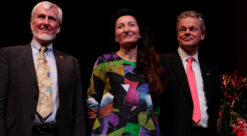
2014 NOBEL PRIZE: Nobel Laureates and neuroscientists May-Britt and Edvard Moser described how they made their prize-winning discovery in their Nobel lectures on Sunday 7 December. They also gave the audience a tantalizing glimpse into new findings, including the existence of speed cells in the brain, and how odours and memory are linked.

2014 NOBEL PRIZE: Edvard and May-Britt Moser finished their Nobel lecture with a music video where NTNU music professors improvised over a Norwegian folk tune. The video was filmed in a dense fog where viewers see the faces of the musicians as they play.
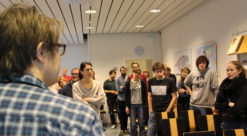
2014 NOBEL PRIZE: When May-Britt Moser gave her Nobel lecture on Sunday, she had some help from the audience. At her signal Moser’s colleagues stood up in the audience and made popping sounds. These are the sounds that the scientists hear when rat brain cells communicate with each other.
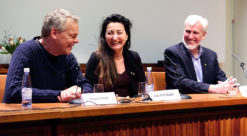
2014 NOBEL PRIZE: Watch the Nobel lectures on Physiology or Medicine via live stream on Sunday 7 December.
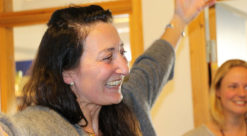
2014 NOBEL PRIZE: Nobel laureate and NTNU Professor May-Britt Moser was full of joy when she learned she had won the 2014 Nobel Prize in Physiology or Medicine with her husband, Edvard Moser, and their former mentor, John O’Keefe.
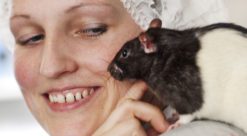
2014 NOBEL PRIZE: Animal welfare is important for Nobel laureates May-Britt and Edvard Moser. Not just because that is how it should be, but also because the researchers get the best results that way.
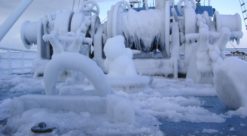
The production of oil and gas at temperatures between 40 and 60 degrees below zero means that researchers must advance the development of materials that can withstand these harsh conditions.
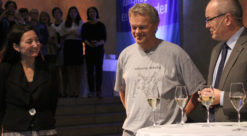
2014 NOBEL PRIZE — There’s a proverb – the origins of which are hotly disputed – that says “It takes a village to raise a child.” You could almost say the same thing about groundbreaking discoveries in neuroscience, if NTNU’s Kavli Institute for Systems Neuroscience/Centre for Neural Computation (KI/CNC) is any example.
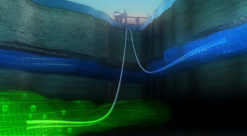
Norwegian researchers and a small company in Tromsø are taking part in a project aimed at preventing between 30 and 50 per cent of Europe’s drinking water being lost due to pipe leakages.
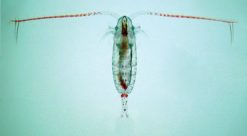
Calanus finmarchicus makes up about 90 per cent of the bottom of the food chain in northern oceans, and is eaten by fish and baleen whales alike, but as the ocean becomes more acidic due to CO2 emissions, populations may decrease dramatically.
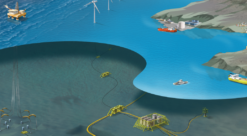
Embryonic faults in subsea high voltage installations are difficult to detect and very expensive to repair. Researchers believe that self-repairing materials could be the answer.
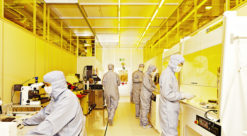
When the oil runs out, Norway will have to depend on nanotechnology as its main source of income. Nanotechnology is all about creating custom materials on a tiny scale that allows for incredible possibilities in the real world.
On Thursday October 3, Canada switched on the largest CO2-free coal-fired power station in the world. Norway could follow up.
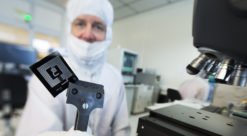
Norwegian researchers are developing electronics that disappear to order.
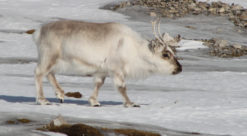
The last week of January 2012 brought wild weather to the Norwegian arctic island archipelago of Svalbard and its largest town, Longyearbyen. A new cross-disciplinary study provides a comprehensive look at the effects of this extreme weather event on everything from town infrastructure to the natural environment.

Women who experience abuse from someone they know have an 80 per cent higher chance of developing postpartum depression as women who have never been abused.
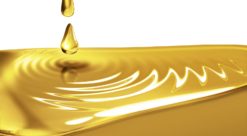
Carlos Alberto Dorao is trying to nail down the mechanisms that will help make processes used in the oil and gas industry more effective. His work may also contribute to making computer processors more powerful.
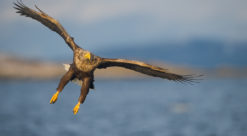
DNA profiles of the sea eagle population from a large island in mid-Norway are providing new and useful information as to how the birds avoid being killed by wind turbines.
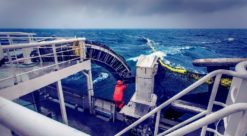
Robots equipped with machine vision enable us to classify catches on board vessels with high levels of accuracy – saving fishing crews time and money.
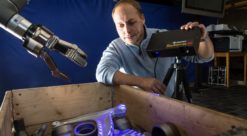
The robots of the future must be able to adapt to changes in their surroundings. Some of them will be in close contact with people. At the very least they must be able to see properly – in three dimensions, just like us.

Women who have complications during pregnancy are at a much higher risk for cardiovascular disease. Now, information from 30 000 women will make a huge contribution to preventing disease and saving lives.
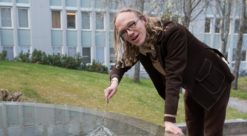
It’s been this way for 127 years— the V-shaped wake pattern behind a ship moving in a straight line always has the same central angle. But a Norwegian armed with a pen and a piece of paper has discovered that in certain situations, a boat’s wake can actually be found in front of the boat.

NTNU researchers have made a discovery that can be key to the development of faster computers that use less energy.
Researchers have been looking into how we can reduce the salt content in foods without compromising on taste.