What type of paths do we need to encourage more people to cycle all year round?
Even in Norway, more people than ever are cycling in winter. But what types of cycle paths are best for the cyclist, the bike, the path itself and the environment?

Even in Norway, more people than ever are cycling in winter. But what types of cycle paths are best for the cyclist, the bike, the path itself and the environment?
We shouldn’t be too worried that conversational agents such as ChatGPT might be making cheats of our pupils. Schools should be empowering them to try out new technologies.

Many infant formulas purport to be healthy in several ways. But the evidence is often razor thin. The companies usually manage the research themselves.

Perhaps you’ve heard about it and are wondering exactly what the EU taxonomy is – and what it really means. SINTEF researcher Mathias Irgens is ready with an explanation.
Many Norwegian homes can only be heated using electricity. The authors of this blog argue that in the event of an extended power outage, energy-efficient homes will stay warm for much longer than those built according to the minimum regulatory requirements.
A comprehensive analysis of 870 power plants worldwide shows that nuclear power is a clear winner in protecting ecosystems. Bioenergy is a sure loser.

For some children with obsessive-compulsive disorder, therapy via the internet and apps can be more effective than physically attending treatment sessions.
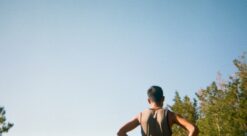
Never before have more people been displaced. How should schools receive youth with a refugee background whose experience is that their opinion has no value?
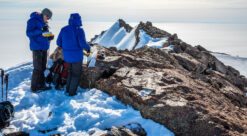
The ice sheet in Queen Maud Land in East Antarctica is not stable. Large amounts of ice have melted in the past, most recently as 5,000 years ago.
An NTNU professor has been awarded an ERC Advanced Grant to investigate how species can survive a changing environment.
Norwegian oil and gas companies are now plugging and abandoning production wells using an artificial ‘lava’. So far, the results have been excellent. Recent laboratory results indicate that the same method can be used to seal subsurface CO2 storage reservoirs.

Sometimes you become so absorbed in a task that you forget everything else. We call it finding the flow. A new test can measure it.
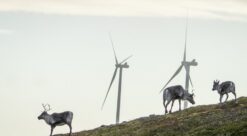
Wind turbines are contributing to the Southern Sámi losing grazing land for their reindeer husbandry. This livelihood is central to the identity of the Southern Sámi culture and thus to their language, researchers say.

It has taken 18 years, but Professor Marit Otterlei has now created a completely new type of cancer medicine. No similar medication has progressed this far in development worldwide.
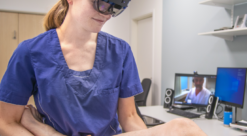
Imagine being treated ‘in hospital’ via an advanced VR headset! Researchers are now making this possible with the help of local ‘health rooms’ and so-called ‘augmented reality’. Results from their experiments have so far proved to be quite promising.
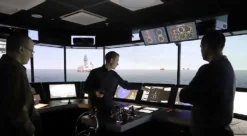
The risk of cyber attacks against a ship is real. The working crew on board must be allowed to practice handling these risks in a realistic way. Now they can.
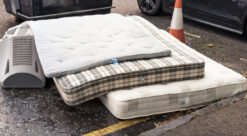
Researchers calculated the total carbon footprint of a bed. Then they discovered it was possible to halve it.

A simple test saves lives. Three out of four women who died of cervical cancer in the screening age of 25-69 years had not had a Pap smear in the past three and a half years.

The Norwegian power grid needs relief during periods when ‘everyone’ is using electricity. Research is showing that variable pricing for the fast charging of electric cars may offer a solution.

The conventional view has been that after the Second World War, Norway was impoverished and plundered, but the recovery actually went quite quickly. All the infrastructure that the occupying power built during the war played a significant role.

The more comfortable students feel at school, the better they feel they are mastering the subject matter.
As consumers, we have all from time to time experienced buying faulty items, whether they be smart phones, washing machines or cars. Researchers now believe that this is a thing of the past.
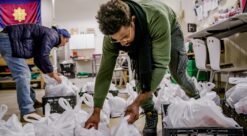
We might imagine that the differences between people in Norway are small, but this is not true. On the contrary, inequities have increased in recent years. And it matters who your parents are.
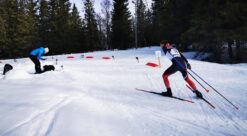
Skiers can gain on their competitors by having a detailed plan of what to do on the uphills. Timing their push at exactly the right moment is key to avoid expending too much effort.