NTNU Amos is an expansive ocean research and innovation community that’s composed of both highly honed specialist expertise and an incredibly broad scope of knowledge. It also adheres to a popular Norwegian football strategy: Develop talents by allowing them to do what they do best – and playing to each other’s strengths.
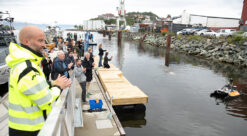
The Nyhavna industrial area in Trondheim, which is being developed into a new mixed-use neighbourhood, has seen significant maritime technology research and innovation. NTNU Nyhavna for autonomous vessels is now officially opened.
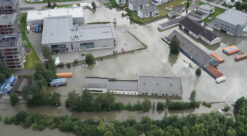
An extreme storm in Norway called Hans has accelerated the debate about how we should build and where we can live. Adapting to wilder and wetter weather also means that engineers are exposed to greater ethical pressure.
Arctic researchers have travelled north to study ice and life in the Arctic Ocean. They discovered a creature at a depth of 3500 metres, a “dumbo octopus” dancing in the deep waters in a ballerina’s skirt.
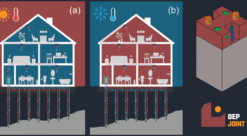
Using a completely new piling joint, geothermal heat can be extracted directly via the piles used to anchor buildings in the ground. The invention makes it easier, quicker, cheaper and safer to use environmentally friendly energy.
The Norwegian government has proposed opening an area of the continental shelf to deep sea mining. NTNU researchers have worked for more than a decade on this issue. They say we have much to learn before Norway can decide if this can become a viable industry.
The discovery of what may be Mjøsa’s oldest known shipwreck to date drew international attention just before last Christmas. The researchers have now secured a video of “Storfjorden I.”
Fossil fuel vehicles gulp down petrol, and electric cars gobble up minerals. The battery industry is so ravenous for lithium as a raw material that researchers believe the demand could threaten climate goals.
Norway has seen an increase in solar power capacity in recent years, but in winter solar panels face a big problem: snow. Researchers modelled how much extra electricity could be generated if solar panel surfaces were designed to repel snow and ice.
Hydrogen is found in large quantities on Earth, can be used in many contexts and is being promoted as an important solution in the transition to climate-friendly energy. But hydrogen investment also generates heated debate. So what’s the deal with hydrogen?
The risk of cyber attacks against a ship is real. The working crew on board must be allowed to practice handling these risks in a realistic way. Now they can.
When countries shut down during the pandemic, many people stayed home. Some replaced their old habits with new ones, either temporarily until society opened up again or continuing post-pandemic. What do these changes in habit mean for our travel patterns?
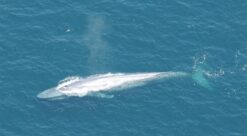
Climate researchers have long known that large animals, like moose, could play a role in how much the Earth will warm due to climate change. But the question is, how much? New research shows the answer can be a lot.
NTNU has tested a system to predict the heating needs on the Gløshaugen campus. The results show that we can save even more where surplus heat is already in use.
Can Europe use the energy crisis to help accelerate its efforts to achieve net zero greenhouse gas emissions by 2050? The EU’s Scientific Advisory Board on Climate Change says yes.
An explosion can hurtle fragments and debris at enormous velocities so they strike the surroundings. Then comes the shock wave. It’s a scary combination.
Covering less than ten per cent of the world’s hydropower reservoirs with floating solar panels would yield as much energy as all hydropower does today, one researcher says.
Cattle farming has often been portrayed as having the most detrimental environmental impact because it takes the most grazing land, uses a lot of water and has large methane emissions. But it’s not the worst. And is locally produced food always best for the environment?
Australia has a seafloor monitoring program where they can precisely surveil the changes in the environment. NTNU has attracted one of the key researchers from this project. Oscar Pizarro’s research goal is to find tools to facilitate continuous observation with less resources.
The Privacy Statement is about how this website collects and uses visitor information. The statement contains information that you are entitled to when collecting information from our website, and general information about how we treat personal data.The legal owner of the website is the processing officer for the processing of personal data. It is voluntary for those who visit the web sites to provide personal information regarding services such as receiving newsletters and using the sharing and tip services. The treatment basis is the consent of the individual, unless otherwise specified.
1. Web analytics and cookies (cookies)
As an important part of the effort to create a user-friendly website, we look at the user pattern of those who visit the site. To analyze the information, we use the Google Analytics analysis tool.Google Analytics uses cookies (small text files that the site stores on the user's computer), which registers the users' IP address and provides information about the individual user's online movements. Examples of what the statistics give us answers to are; how many people visit different pages, how long the visit lasts, what websites users come from and what browsers are used. None of the cookies allow us to link information about your use of the site to you as an individual.The information collected by Google Analytics is stored on Google servers in the U.S.. The information received is subject to the Google Privacy Policy.An IP address is defined as a personal information because it can be traced back to a particular hardware and thus to an individual. We use Google Analytics's tracking code to anonymize the IP address before the information is stored and processed by Google. Thus, the stored IP address can not be used to identify the individual user.
2. Search
If the webpage has search function, it stores information about what keywords users use in Google Analytics. The purpose of the storage is to improve our information service. The search usage pattern is stored in aggregate form. Only the keyword is saved and they can not be linked to other information about the users, such as the IP addresses.
3. Share / Tips service
The "Share with others" feature can be used to forward links to the site by email, or to share the content of social networking. Tips for tips are not logged with us, but only used to add the tips to the community. However, we can not guarantee that the online community does not log this information. All such services should therefore be used wisely. If you use the email feature, we only use the provided email addresses to resend the message without any form of storage.
4. Newsletter
The website can send out newsletters by email if you have registered to receive this. In order for us to be able to send e-mail, you must register an e-mail address. Mailchimp is the data processor for the newsletter. The e-mail address is stored in a separate database, not shared with others and deleted when you unsubscribe. The e-mail address will also be deleted if we receive feedback that it is not active.
5. Registration, form
The website may have a form for registration, contact form or other form. These forms are available to the public to perform the tasks they are supposed to do.Registration form is for visitors to sign up or register.Contact form is for visitors to easily send a message to the website's contact person.We ask for the name of the sender and contact information for this. Personal information we receive is not used for purposes other than responding to the inquiry.The form is sent as email via Mailgun as a third party solution. The entire submission will be stored at Mailgun for 24 hours. Between 24 hours and 30 days, only mailheader is stored before the submission is deleted after 30 days. The reason for this storage is to confirm whether emails are sent from the website and forwarded to the correct recipient.Once the email is received by the recipient, it is up to the recipient to determine the data processing needs of the email.
6. Page and service functionality
Cookies are used in the operation and presentation of data from websites. Such cookies may contain language code information for languages selected by the user. There may be cookies with information supporting the load balancing of the system, ensuring all users the best possible experience. For services that require login or search, cookies can be used to ensure that the service presents data to the right recipient.