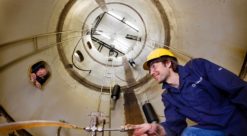
Producing pure aluminium from ore accounts for as much as 1 per cent of all greenhouse gas emissions worldwide. Recycling is the best way to reduce that carbon footprint – but manufacturers and recycling companies will have to plan carefully to avoid problems with impurities that accumulate in recycled aluminium over time.
Tomorrow’s maritime technology must be able to handle extreme conditions during Arctic and deep-water operations. A new research centre designed to develop these technologies holds promise for Norwegian industry.
The Land of the Rising Sun is thinking of importing Norwegian wind and gas by sea in the form of liquid hydrogen. This could offer Norway new prospects for wealth creation and exports, say a pair of Norwegian researchers.
Oil droplets are providing clues about environmental impacts following oil discharges What really happens to the oil that ends up in the sea during a discharge, and how can we minimise the damage?
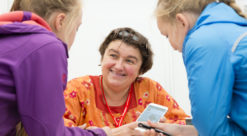
People suffering from cystic fibrosis (CF) are unable to absorb sufficient fats and proteins from the food they eat. But an app is on the way that will help them control their illness.
The Flåm Line railway, the Trans-Iranian railroad, Ethiopian roads and many Norwegian airports. A little known professor and engineer at the Norwegian Institute of Technology (NTH) helped to build them all.
Solar cells will soon become integrated into roofing and exterior facade materials. We will save on construction materials and manpower – and save money on our electricity bills too.
Space elevators, more effective solar cells, super-fast computers. All of these technologies are dependent on new information about the characteristics of nanoparticles. Researchers in Norway are giving us this insight.
Proper and prompt treatment in the emergency room saves lives. With help from Norwegian doctors, a hospital in Nepal has started to sort patients into red, yellow and green categories. The system has made a difference.
This gouge may be the result of a successful parry, says archaeologist Ingrid Ystgaard, referring to the deep notch in the shield’s protective metal boss.
A new report reveals that 76 percent of children and adolescents who live in Norwegian child welfare institutions have serious psychiatric diagnoses. Only 38 percent report that they receive appropriate psychiatric help. One youngster was moved 25 times under the direction of Norway’s Child Welfare Services.
Over half of all infants in the world develop jaundice after birth. Annually over 100,000 infants die as a result of the condition, and increasing numbers of afflicted children are growing up with brain damage
Three million egg-laying hens are destroyed each year. Researchers believe that this practice is inadequately sustainable and want to see the hens exploited for food, oils and proteins.
Earlier this year, students and employees at NTNU’s Nanolab cut a 100-nanometre thick platinum wire. That’s a thickness of just one ten-thousandth of a millimetre.
When racers are chasing hundredths of seconds, the difference between winning and losing is tiny. The type of fabric and seam locations can determine whether a cyclist makes it onto the podium or not
The Privacy Statement is about how this website collects and uses visitor information. The statement contains information that you are entitled to when collecting information from our website, and general information about how we treat personal data.The legal owner of the website is the processing officer for the processing of personal data. It is voluntary for those who visit the web sites to provide personal information regarding services such as receiving newsletters and using the sharing and tip services. The treatment basis is the consent of the individual, unless otherwise specified.
1. Web analytics and cookies (cookies)
As an important part of the effort to create a user-friendly website, we look at the user pattern of those who visit the site. To analyze the information, we use the Google Analytics analysis tool.Google Analytics uses cookies (small text files that the site stores on the user's computer), which registers the users' IP address and provides information about the individual user's online movements. Examples of what the statistics give us answers to are; how many people visit different pages, how long the visit lasts, what websites users come from and what browsers are used. None of the cookies allow us to link information about your use of the site to you as an individual.The information collected by Google Analytics is stored on Google servers in the U.S.. The information received is subject to the Google Privacy Policy.An IP address is defined as a personal information because it can be traced back to a particular hardware and thus to an individual. We use Google Analytics's tracking code to anonymize the IP address before the information is stored and processed by Google. Thus, the stored IP address can not be used to identify the individual user.
2. Search
If the webpage has search function, it stores information about what keywords users use in Google Analytics. The purpose of the storage is to improve our information service. The search usage pattern is stored in aggregate form. Only the keyword is saved and they can not be linked to other information about the users, such as the IP addresses.
3. Share / Tips service
The "Share with others" feature can be used to forward links to the site by email, or to share the content of social networking. Tips for tips are not logged with us, but only used to add the tips to the community. However, we can not guarantee that the online community does not log this information. All such services should therefore be used wisely. If you use the email feature, we only use the provided email addresses to resend the message without any form of storage.
4. Newsletter
The website can send out newsletters by email if you have registered to receive this. In order for us to be able to send e-mail, you must register an e-mail address. Mailchimp is the data processor for the newsletter. The e-mail address is stored in a separate database, not shared with others and deleted when you unsubscribe. The e-mail address will also be deleted if we receive feedback that it is not active.
5. Registration, form
The website may have a form for registration, contact form or other form. These forms are available to the public to perform the tasks they are supposed to do.Registration form is for visitors to sign up or register.Contact form is for visitors to easily send a message to the website's contact person.We ask for the name of the sender and contact information for this. Personal information we receive is not used for purposes other than responding to the inquiry.The form is sent as email via Mailgun as a third party solution. The entire submission will be stored at Mailgun for 24 hours. Between 24 hours and 30 days, only mailheader is stored before the submission is deleted after 30 days. The reason for this storage is to confirm whether emails are sent from the website and forwarded to the correct recipient.Once the email is received by the recipient, it is up to the recipient to determine the data processing needs of the email.
6. Page and service functionality
Cookies are used in the operation and presentation of data from websites. Such cookies may contain language code information for languages selected by the user. There may be cookies with information supporting the load balancing of the system, ensuring all users the best possible experience. For services that require login or search, cookies can be used to ensure that the service presents data to the right recipient.