An extreme storm in Norway called Hans has accelerated the debate about how we should build and where we can live. Adapting to wilder and wetter weather also means that engineers are exposed to greater ethical pressure.
Apps and games make us exercise more often, play more, run further, learn better and work smarter. Meet the innovators who make you do the things you should be doing but that you maybe don’t want to.
Sepsis, or blood poisoning, occurs more frequently than previously estimated by professionals. At the same, mortality rates have declined sharply. The two are connected.
Exercising can be absolutely awful. However, none of our excuses matter when it comes to the health benefits. The benefits go beyond physical health —exercise also has a major impact on mental health.
Arctic researchers have travelled north to study ice and life in the Arctic Ocean. They discovered a creature at a depth of 3500 metres, a “dumbo octopus” dancing in the deep waters in a ballerina’s skirt.
Many children and young adults spend a lot of time on social media, much to the concern of their parents and guardians. Researchers at NTNU have now taken a closer look at the impact of using social media such as Instagram, Snapchat and TikTok on young people’s mental health.
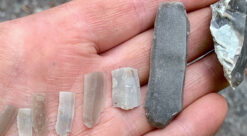
When archaeologists recently carried out an excavation at Vinjeøra in southern Trøndelag County, they made a surprising discovery that they had only dreamed of finding.
Increased cooperation between Norwegian industry and universities on quantum physics sensors is a win-win situation for society. Such sensors can provide new opportunities in areas as diverse as mineral extraction and agriculture.
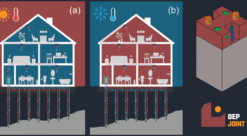
Using a completely new piling joint, geothermal heat can be extracted directly via the piles used to anchor buildings in the ground. The invention makes it easier, quicker, cheaper and safer to use environmentally friendly energy.
“A sense of community between generations will be key to ensuring sustainable coastal communities. The importance of children’s learning through work is underestimated,” says Professor Anne Trine Kjørholt.
The number of lemmings varies greatly from year to year. Other species also have similar fluctuations. Why is it like this, and what happens if lemming years happen less often?
“Doctors should look at the length of pregnancy in patients with respiratory problems,” says researcher Kari Risnes. But if you were born before your due date, you can take some measures yourself to prevent lung infections.
Hypertension affects one billion people and is considered the number one cause of death worldwide. Mass testing of genetic variants can now shed light on the cause of high blood pressure.
Women’s health continues to be given low priority. But a new video provides important information on how to strengthen the pelvic floor after childbirth.
The Privacy Statement is about how this website collects and uses visitor information. The statement contains information that you are entitled to when collecting information from our website, and general information about how we treat personal data.The legal owner of the website is the processing officer for the processing of personal data. It is voluntary for those who visit the web sites to provide personal information regarding services such as receiving newsletters and using the sharing and tip services. The treatment basis is the consent of the individual, unless otherwise specified.
1. Web analytics and cookies (cookies)
As an important part of the effort to create a user-friendly website, we look at the user pattern of those who visit the site. To analyze the information, we use the Google Analytics analysis tool.Google Analytics uses cookies (small text files that the site stores on the user's computer), which registers the users' IP address and provides information about the individual user's online movements. Examples of what the statistics give us answers to are; how many people visit different pages, how long the visit lasts, what websites users come from and what browsers are used. None of the cookies allow us to link information about your use of the site to you as an individual.The information collected by Google Analytics is stored on Google servers in the U.S.. The information received is subject to the Google Privacy Policy.An IP address is defined as a personal information because it can be traced back to a particular hardware and thus to an individual. We use Google Analytics's tracking code to anonymize the IP address before the information is stored and processed by Google. Thus, the stored IP address can not be used to identify the individual user.
2. Search
If the webpage has search function, it stores information about what keywords users use in Google Analytics. The purpose of the storage is to improve our information service. The search usage pattern is stored in aggregate form. Only the keyword is saved and they can not be linked to other information about the users, such as the IP addresses.
3. Share / Tips service
The "Share with others" feature can be used to forward links to the site by email, or to share the content of social networking. Tips for tips are not logged with us, but only used to add the tips to the community. However, we can not guarantee that the online community does not log this information. All such services should therefore be used wisely. If you use the email feature, we only use the provided email addresses to resend the message without any form of storage.
4. Newsletter
The website can send out newsletters by email if you have registered to receive this. In order for us to be able to send e-mail, you must register an e-mail address. Mailchimp is the data processor for the newsletter. The e-mail address is stored in a separate database, not shared with others and deleted when you unsubscribe. The e-mail address will also be deleted if we receive feedback that it is not active.
5. Registration, form
The website may have a form for registration, contact form or other form. These forms are available to the public to perform the tasks they are supposed to do.Registration form is for visitors to sign up or register.Contact form is for visitors to easily send a message to the website's contact person.We ask for the name of the sender and contact information for this. Personal information we receive is not used for purposes other than responding to the inquiry.The form is sent as email via Mailgun as a third party solution. The entire submission will be stored at Mailgun for 24 hours. Between 24 hours and 30 days, only mailheader is stored before the submission is deleted after 30 days. The reason for this storage is to confirm whether emails are sent from the website and forwarded to the correct recipient.Once the email is received by the recipient, it is up to the recipient to determine the data processing needs of the email.
6. Page and service functionality
Cookies are used in the operation and presentation of data from websites. Such cookies may contain language code information for languages selected by the user. There may be cookies with information supporting the load balancing of the system, ensuring all users the best possible experience. For services that require login or search, cookies can be used to ensure that the service presents data to the right recipient.