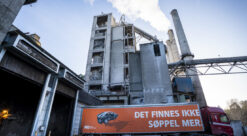
When will we see a ‘Spotify’ for spare parts?
Vessel components are being transported all around the world when just a simple datafile would suffice.

Vessel components are being transported all around the world when just a simple datafile would suffice.
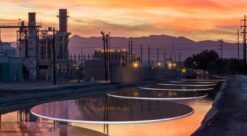
Researchers are planning a solar energy plant that will capture ‘concentrated sunlight’ using mirrors. The plant will also be distinctive because it will generate both electricity and heat, which can be used to capture carbon dioxide.
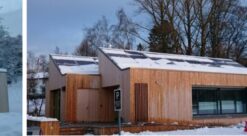
Norway has seen an increase in solar power capacity in recent years, but in winter solar panels face a big problem: snow. Researchers modelled how much extra electricity could be generated if solar panel surfaces were designed to repel snow and ice.

Are remote video consultations appropriate for treating children and young people under the care of the child welfare services? Therapists recognise a number of benefits, but most young people are critical of webcam-based therapy.

The magnets in wind turbines come from China, and the materials in our electric car batteries are for the most part sourced from Congo. Today, key minerals and metals are being transported to Europe from politically unstable countries far away. Is it possible to safeguard access to these raw materials here in Norway? In this article, we present three research-based strategies for addressing the problem.
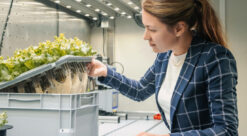
NASA has finished its planning and is ready to go. Humans will soon be returning to the Moon – this time in a manned base. But, if this project is to succeed, astronauts must be able to grow their own food. Norwegian researchers are in the process of making this possible.
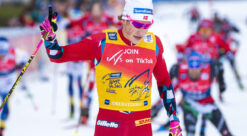
What we are seeing on our TV screens has now been confirmed by science. Johannes Høsflot Klæbo ticks all the boxes defined by researchers looking for the most important factors needed for success in mass start cross-country ski racing.
Even in Norway, more people than ever are cycling in winter. But what types of cycle paths are best for the cyclist, the bike, the path itself and the environment?
We shouldn’t be too worried that conversational agents such as ChatGPT might be making cheats of our pupils. Schools should be empowering them to try out new technologies.

Perhaps you’ve heard about it and are wondering exactly what the EU taxonomy is – and what it really means. SINTEF researcher Mathias Irgens is ready with an explanation.
Many Norwegian homes can only be heated using electricity. The authors of this blog argue that in the event of an extended power outage, energy-efficient homes will stay warm for much longer than those built according to the minimum regulatory requirements.
Norwegian oil and gas companies are now plugging and abandoning production wells using an artificial ‘lava’. So far, the results have been excellent. Recent laboratory results indicate that the same method can be used to seal subsurface CO2 storage reservoirs.
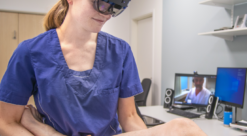
Imagine being treated ‘in hospital’ via an advanced VR headset! Researchers are now making this possible with the help of local ‘health rooms’ and so-called ‘augmented reality’. Results from their experiments have so far proved to be quite promising.
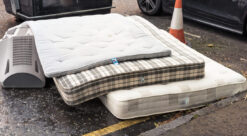
Researchers calculated the total carbon footprint of a bed. Then they discovered it was possible to halve it.

The Norwegian power grid needs relief during periods when ‘everyone’ is using electricity. Research is showing that variable pricing for the fast charging of electric cars may offer a solution.
As consumers, we have all from time to time experienced buying faulty items, whether they be smart phones, washing machines or cars. Researchers now believe that this is a thing of the past.

Skiers can gain on their competitors by having a detailed plan of what to do on the uphills. Timing their push at exactly the right moment is key to avoid expending too much effort.
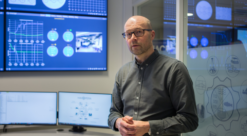
Now, in 2023, there are almost no limits to how much data we can collect and store away. But what can we use all this information for, and how do we find out what the data can tell us?
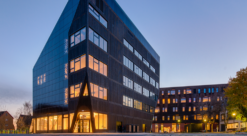
The ZEB Laboratory has been utilised both as an office building and a sustainable construction laboratory for about two years. It was designed to be the world’s most ambitious ‘climate-adapted building’ and up to now it has been a great success.

Christian John Engelsen at SINTEF is teaching the world to recycle demolition rubble to make new concrete. Anything and everything can be recycled, he says. What takes time is getting people on board.
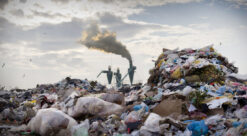
There are plans in Årdal to build a waste incineration plant based on a new technology that captures and stores CO2, thus removing the greenhouse gas from the atmosphere.
Many managers believe that their efforts to promote a healthy psychosocial working environment are succeeding. According to a recent report, however, many employees do not agree. No surprise, perhaps, since it appears that people are defining the concept in different ways.
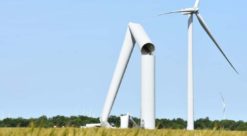
Ships, bridges and wind turbines can all be made safe using sensors that are just a few millimetres across. Researchers have borrowed the principle behind the technology from a vibrating guitar string.
At last it is now possible to capture CO2 at industrial scales without state subsidy, and countries across the world should be persuading private industry to identify storage sites that will make a real difference.