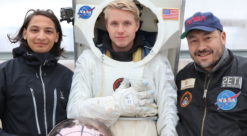
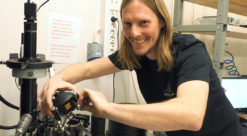
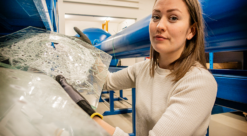
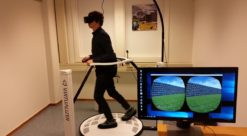
NTNU students have developed a smart glove for astronauts that can be used while exploring other planets. NASA partners recently conducted successful testing of the glove at the Haughton Mars Project research station.
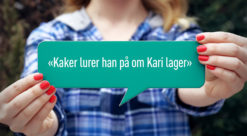
Moving a word to the beginning of a sentence is a useful trick to draw attention to the most important topic you want to relay. The researchers of a new study have found that the Scandinavian languages are unique in their use of this technique.
Humankind will need to harness carbon capture and storage technologies to help keep global warming to 2 degrees C or less. New research shows that there’s plenty of room to store captured CO2 — in offshore geologic rock formations.
Cybernetics professor Kristin Ytterstad Pettersen has been awarded the BODE prize for her groundbreaking research in underwater robotics. It is one of the most prestigious technology prizes in the world.
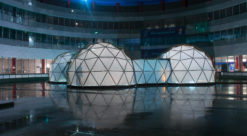
Can art that literally takes your breath away make you more climate friendly? You can find out yourself if you happen to be in Madrid, at the UN Climate Change Conference, COP 25.
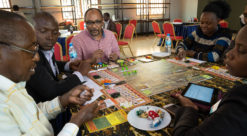
Researchers wanted to involve local people living around Kenya and Tanzania’s Serengeti-Mara parks in developing a sustainable future for them and the parks. They developed a board game to get people talking to the researchers — and to each other. That game has now won an international award.
Professor Dennis Meier and the research team he leads will create the world’s smallest electronic network. Dennis Meier has been awarded the ERC Consolidator Grant to conduct this research.
Lithium from Norwegian electric car batteries isn’t recycled that often. Instead, it ends up as waste when other metals it’s mixed with are recycled. But this may change.
When scientists carry out experiments to investigate safe and efficient CO2 transport on the roof of the thermal power engineering laboratories at Trondheim, Norway, the noise they make will sound like a jet engine.
In the classroom, non-educational distractions are only a click or two away. However, a recent SINTEF report demonstrates that these thieves of school pupils’ attention are already being severely weakened.
When accidents happen, the difference between life and death may come down to the materials of the car, boat or building that you find yourself in. The best possible protection requires understanding as much as possible about how different materials behave under stress.
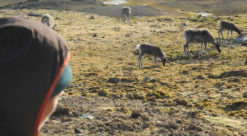
As reindeer go, the animals living on Svalbard might not be Santa’s first choice. They’re a smaller subspecies of their common mainland relatives, and to save energy they basically never run. But because they were nearly exterminated from Svalbard around 1900 — and were then protected in 1925 — the animals provide unique insights into how conservation can help species thrive.
Researcher Marita Skjuve has been interviewing people who have a close relationship with a chatbot called Replika. Her conclusion is that such relationships offer value and meaning to the chatbot’s users, and can even be romantic.
Moose prefer to browse on deciduous trees. Then conifers take over and affect the species diversity in the forest. One researcher contends that Norwegian wildlife management is not good enough to address what happens in the wake of these large herbivores.
Floods are expensive and at times dangerous. But what if a computer disaster simulation game could show politicians and local people what potential floods in their town would look like?
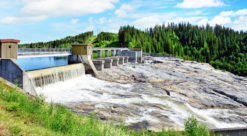
The Norwegian public authorities’ estimates of the potential to expand the country’s power plants are probably too low. A new approach is creating opportunities for increased production while also enhancing environmental aspects.
You may feel like you can’t do anything to stop climate change. But climate activists who joined in grassroots movements managed to cut their carbon footprints and were still happier than their non-activist peers, new research shows.
Our craving for daylight has accelerated the use of glass in modern buildings. However, for people concerned about safety, our passion for the light comes with a dark side.
We create mental maps as we move around. But these maps can be distorted if the surroundings change. That makes it more difficult to remember where something was.
The Privacy Statement is about how this website collects and uses visitor information. The statement contains information that you are entitled to when collecting information from our website, and general information about how we treat personal data.The legal owner of the website is the processing officer for the processing of personal data. It is voluntary for those who visit the web sites to provide personal information regarding services such as receiving newsletters and using the sharing and tip services. The treatment basis is the consent of the individual, unless otherwise specified.
1. Web analytics and cookies (cookies)
As an important part of the effort to create a user-friendly website, we look at the user pattern of those who visit the site. To analyze the information, we use the Google Analytics analysis tool.Google Analytics uses cookies (small text files that the site stores on the user's computer), which registers the users' IP address and provides information about the individual user's online movements. Examples of what the statistics give us answers to are; how many people visit different pages, how long the visit lasts, what websites users come from and what browsers are used. None of the cookies allow us to link information about your use of the site to you as an individual.The information collected by Google Analytics is stored on Google servers in the U.S.. The information received is subject to the Google Privacy Policy.An IP address is defined as a personal information because it can be traced back to a particular hardware and thus to an individual. We use Google Analytics's tracking code to anonymize the IP address before the information is stored and processed by Google. Thus, the stored IP address can not be used to identify the individual user.
2. Search
If the webpage has search function, it stores information about what keywords users use in Google Analytics. The purpose of the storage is to improve our information service. The search usage pattern is stored in aggregate form. Only the keyword is saved and they can not be linked to other information about the users, such as the IP addresses.
3. Share / Tips service
The "Share with others" feature can be used to forward links to the site by email, or to share the content of social networking. Tips for tips are not logged with us, but only used to add the tips to the community. However, we can not guarantee that the online community does not log this information. All such services should therefore be used wisely. If you use the email feature, we only use the provided email addresses to resend the message without any form of storage.
4. Newsletter
The website can send out newsletters by email if you have registered to receive this. In order for us to be able to send e-mail, you must register an e-mail address. Mailchimp is the data processor for the newsletter. The e-mail address is stored in a separate database, not shared with others and deleted when you unsubscribe. The e-mail address will also be deleted if we receive feedback that it is not active.
5. Registration, form
The website may have a form for registration, contact form or other form. These forms are available to the public to perform the tasks they are supposed to do.Registration form is for visitors to sign up or register.Contact form is for visitors to easily send a message to the website's contact person.We ask for the name of the sender and contact information for this. Personal information we receive is not used for purposes other than responding to the inquiry.The form is sent as email via Mailgun as a third party solution. The entire submission will be stored at Mailgun for 24 hours. Between 24 hours and 30 days, only mailheader is stored before the submission is deleted after 30 days. The reason for this storage is to confirm whether emails are sent from the website and forwarded to the correct recipient.Once the email is received by the recipient, it is up to the recipient to determine the data processing needs of the email.
6. Page and service functionality
Cookies are used in the operation and presentation of data from websites. Such cookies may contain language code information for languages selected by the user. There may be cookies with information supporting the load balancing of the system, ensuring all users the best possible experience. For services that require login or search, cookies can be used to ensure that the service presents data to the right recipient.