The world’s largest electric car manufacturer and the Swedish trade union movement are at loggerheads. Could Tesla owner Elon Musk have more to gain than he realizes by joining Nordic unions?
Elite sports women who want to have children face a number of dilemmas: how will motherhood affect their performance and body? Finances? Family life? Researchers have taken a closer look.
Greenland’s glaciers are melting and the surrounding seawater is getting warmer. How are arctic char coping with climate change? Scientists are in the process of figuring it out.
Norway will reap major environmental benefits if residents stop sending wearable clothes out of the country, according to a recent study on clothing consumption in Norwegian households.
In the sea, fish feed on species lower in the food chain. Can these same species form the basis of a new feed industry supplying the fish farming sector?
Lectures continue to dominate university teaching, but especially when it comes to big introductory courses, more group work and alternative assignments, such as making podcasts, can have a positive effect.
The transition to a greener, renewable economy will require large amounts of minerals, and society has to get them from somewhere. Norwegian politicians have reached an agreement approving deep sea mining, in a proposal that has reaped both cheers and frustration from scientists and activists alike. Here’s what our scientists think.
Researchers in Trondheim are developing a new medicine for diabetics who have to have daily injections of insulin. The key is a hormone that causes the smallest blood vessels to relax on the inside.
Farmed fish suffer if there is too little oxygen in the water. A system that can display oxygen concentrations may make it easier to supply this essential gas if the water becomes oxygen-poor.
Children in severe pain do not receive enough help. Nasal spray painkillers could be a solution for children who are scared of needles. National guidelines may be changed as a result.
Tonnes of waste from standard plastic products have been uncontrollably released into the world’s oceans, where they gradually break down. But how harmful is this plastic to living organisms, and what is it in these plastics that is so damaging?
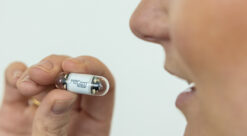
Norway has one of the highest prevalences of intestinal cancer in Europe, and this year sees the national screening programme being rolled out in full. But where do the capsule cameras go?
Scientists at NTNU’s Kavli Institute for Systems Neuroscience in Norway have discovered a pattern of activity in the brain that serves as a template for building sequential experiences.
Greener data processing requires systems that work smarter, faster, and are more energy efficient. Researchers from NTNU have developed a tiny piece of super-smart hardware that enables all of the above.
Road pricing may soon be replacing toll charges on Norwegian roads. But researchers still don’t know if this will help to reduce and regulate road traffic.
NTNU has developed a promising antibiotic candidate against MRSA. Behind the discovery lies a methodology that may be important in the fight against antimicrobial resistance.
The 1,283 workers in the aquaculture sector who have responded to a recent HSE survey are not anxious without good reason. Sixty-two percent have experienced ‘near misses’ in the last two years. However, there is another threat that is making them even more worried.
The Privacy Statement is about how this website collects and uses visitor information. The statement contains information that you are entitled to when collecting information from our website, and general information about how we treat personal data.The legal owner of the website is the processing officer for the processing of personal data. It is voluntary for those who visit the web sites to provide personal information regarding services such as receiving newsletters and using the sharing and tip services. The treatment basis is the consent of the individual, unless otherwise specified.
1. Web analytics and cookies (cookies)
As an important part of the effort to create a user-friendly website, we look at the user pattern of those who visit the site. To analyze the information, we use the Google Analytics analysis tool.Google Analytics uses cookies (small text files that the site stores on the user's computer), which registers the users' IP address and provides information about the individual user's online movements. Examples of what the statistics give us answers to are; how many people visit different pages, how long the visit lasts, what websites users come from and what browsers are used. None of the cookies allow us to link information about your use of the site to you as an individual.The information collected by Google Analytics is stored on Google servers in the U.S.. The information received is subject to the Google Privacy Policy.An IP address is defined as a personal information because it can be traced back to a particular hardware and thus to an individual. We use Google Analytics's tracking code to anonymize the IP address before the information is stored and processed by Google. Thus, the stored IP address can not be used to identify the individual user.
2. Search
If the webpage has search function, it stores information about what keywords users use in Google Analytics. The purpose of the storage is to improve our information service. The search usage pattern is stored in aggregate form. Only the keyword is saved and they can not be linked to other information about the users, such as the IP addresses.
3. Share / Tips service
The "Share with others" feature can be used to forward links to the site by email, or to share the content of social networking. Tips for tips are not logged with us, but only used to add the tips to the community. However, we can not guarantee that the online community does not log this information. All such services should therefore be used wisely. If you use the email feature, we only use the provided email addresses to resend the message without any form of storage.
4. Newsletter
The website can send out newsletters by email if you have registered to receive this. In order for us to be able to send e-mail, you must register an e-mail address. Mailchimp is the data processor for the newsletter. The e-mail address is stored in a separate database, not shared with others and deleted when you unsubscribe. The e-mail address will also be deleted if we receive feedback that it is not active.
5. Registration, form
The website may have a form for registration, contact form or other form. These forms are available to the public to perform the tasks they are supposed to do.Registration form is for visitors to sign up or register.Contact form is for visitors to easily send a message to the website's contact person.We ask for the name of the sender and contact information for this. Personal information we receive is not used for purposes other than responding to the inquiry.The form is sent as email via Mailgun as a third party solution. The entire submission will be stored at Mailgun for 24 hours. Between 24 hours and 30 days, only mailheader is stored before the submission is deleted after 30 days. The reason for this storage is to confirm whether emails are sent from the website and forwarded to the correct recipient.Once the email is received by the recipient, it is up to the recipient to determine the data processing needs of the email.
6. Page and service functionality
Cookies are used in the operation and presentation of data from websites. Such cookies may contain language code information for languages selected by the user. There may be cookies with information supporting the load balancing of the system, ensuring all users the best possible experience. For services that require login or search, cookies can be used to ensure that the service presents data to the right recipient.