Recent research indicates that the best environmental solution is in fact to install less insulation in our homes and consume more electricity for heating. But first, some preconditions have to be met.
Four of the six Gulf States are among the top five biggest greenhouse gas emitters per capita. Why? Oil is the answer, but not quite in the way you might think.
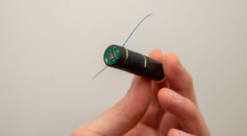
Sick and injured farmed salmon are a problem, but researchers have recently developed an implant that uses sensors to gather information about the welfare of individual fish.
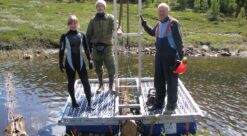
What should power the future’s shipping fleets? How can we change the way we build buildings so that they’re truly climate neutral? If we’re going to actively alter the planet’s climate, how should we study this?
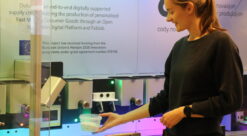
Researchers have recently discovered a new way of making consumer items. They’ve developed a machine, based on AI technology, that can customise personal care products to your own requirements.
Women continue to be underrepresented in senior positions in international sport organizations. New findings reveal more about the reasons why and offer advice on what to do about it.
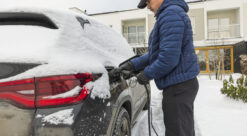
Up until now, car manufacturers and others have been recommending using electricity from the grid to warm up your car on cold winter mornings because this will save the battery and ensure maximum range. But research is showing that this isn’t always necessary. Nor does it save you money.
The addition of slag has been shown to reduce greenhouse gas emissions from concrete manufacture by more than 95 per cent. Researchers have now discovered that the concrete delivers.
Researchers at NTNU have come up with a remarkably simple method to solve a problem known as probe wandering in a transmission electron microscopy based technique.
We think of trees as silent sentinels, watching as the world goes by and the ages pass. But what if you could interview them about what they have seen?
NTNU’s largest laboratory – the Trondheim fjord – is something of an Eldorado for researchers developing underwater robots. A charging station has been installed on the seabed, and to ensure the robots can find the shortest route to the charging station, they train in the fjord.
SINTEF researchers have been testing different types of water distribution cabinets. Cabinets that combine the distribution of both domestic tap water and water for floor heating, are now shown to represent an unnecessary risk of Legionnaires’ disease.
Several whale species disappeared from Europe long before whaling became a major industry. Two of the most common species are no longer found here, and one of them is almost extinct.
Last week, the Hungarian Katalin Karikó and the American Drew Weissman were awarded the Nobel Prize for Medicine for their research into the mRNA-technology applied to develop the vaccines used to combat Covid-19. But what exactly is mRNA technology?
In the future, we will see the emergence of local energy communities made up of households and businesses who buy and sell electricity among themselves. But someone will have to work out how to determine the price.
Solar panels installed on roofs and facades increase the fire risk. However, research shows that small changes in construction can make a big difference.
More than 80 years ago, Norwegian teachers refused to teach Nazi ideology to their students. They were tortured, imprisoned and starved. But they prevailed. The story of how they won — and why it still matters.
The Privacy Statement is about how this website collects and uses visitor information. The statement contains information that you are entitled to when collecting information from our website, and general information about how we treat personal data.The legal owner of the website is the processing officer for the processing of personal data. It is voluntary for those who visit the web sites to provide personal information regarding services such as receiving newsletters and using the sharing and tip services. The treatment basis is the consent of the individual, unless otherwise specified.
1. Web analytics and cookies (cookies)
As an important part of the effort to create a user-friendly website, we look at the user pattern of those who visit the site. To analyze the information, we use the Google Analytics analysis tool.Google Analytics uses cookies (small text files that the site stores on the user's computer), which registers the users' IP address and provides information about the individual user's online movements. Examples of what the statistics give us answers to are; how many people visit different pages, how long the visit lasts, what websites users come from and what browsers are used. None of the cookies allow us to link information about your use of the site to you as an individual.The information collected by Google Analytics is stored on Google servers in the U.S.. The information received is subject to the Google Privacy Policy.An IP address is defined as a personal information because it can be traced back to a particular hardware and thus to an individual. We use Google Analytics's tracking code to anonymize the IP address before the information is stored and processed by Google. Thus, the stored IP address can not be used to identify the individual user.
2. Search
If the webpage has search function, it stores information about what keywords users use in Google Analytics. The purpose of the storage is to improve our information service. The search usage pattern is stored in aggregate form. Only the keyword is saved and they can not be linked to other information about the users, such as the IP addresses.
3. Share / Tips service
The "Share with others" feature can be used to forward links to the site by email, or to share the content of social networking. Tips for tips are not logged with us, but only used to add the tips to the community. However, we can not guarantee that the online community does not log this information. All such services should therefore be used wisely. If you use the email feature, we only use the provided email addresses to resend the message without any form of storage.
4. Newsletter
The website can send out newsletters by email if you have registered to receive this. In order for us to be able to send e-mail, you must register an e-mail address. Mailchimp is the data processor for the newsletter. The e-mail address is stored in a separate database, not shared with others and deleted when you unsubscribe. The e-mail address will also be deleted if we receive feedback that it is not active.
5. Registration, form
The website may have a form for registration, contact form or other form. These forms are available to the public to perform the tasks they are supposed to do.Registration form is for visitors to sign up or register.Contact form is for visitors to easily send a message to the website's contact person.We ask for the name of the sender and contact information for this. Personal information we receive is not used for purposes other than responding to the inquiry.The form is sent as email via Mailgun as a third party solution. The entire submission will be stored at Mailgun for 24 hours. Between 24 hours and 30 days, only mailheader is stored before the submission is deleted after 30 days. The reason for this storage is to confirm whether emails are sent from the website and forwarded to the correct recipient.Once the email is received by the recipient, it is up to the recipient to determine the data processing needs of the email.
6. Page and service functionality
Cookies are used in the operation and presentation of data from websites. Such cookies may contain language code information for languages selected by the user. There may be cookies with information supporting the load balancing of the system, ensuring all users the best possible experience. For services that require login or search, cookies can be used to ensure that the service presents data to the right recipient.