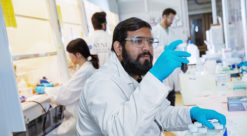
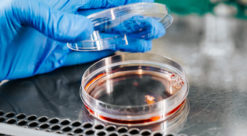
Lybe Scientific, a start-up company based on NTNU research, is entering the market as a provider of high-quality diagnostic solutions – not just for COVID-19 diagnostics, but also other areas such as the common flu and sexually transmitted diseases.
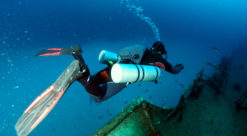
An NTNU researcher has discovered what happens in the genes of divers with decompression sickness. The breakthrough is gaining international attention after more than a century of searching for the causes of divers’ disease.
A psychiatrist’s study reviewed more than 200 rape cases and found that the most vulnerable women who were raped received the worst follow-up by the police.
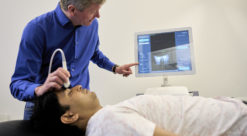
A new invention may be on the verge of replacing a costly cranial surgical procedure currently being performed on some traffic accident victims and other patient groups. The ultrasound-based technology has now been granted CE approval for the European market.
Do you find it easier to remember exactly where something is located rather than remembering exactly what is there? In that case, your experience is in sync with NTNU brain researchers’ new findings about memory.
A tiny region in the middle of the brain plays a far more important role than previously known in helping it respond to changes in the environment, a new study shows.
For the first time, researchers have shown how cancer cells reprogram themselves to produce lactic acid and to tolerate the acidic environment that exists around tumours. The finding could lead to a whole new direction for treating cancer.
In neonatal medicine, there is a grey area where professionals may be uncertain whether it is in the child’s best interests to start life-saving treatment. Without it, the infant dies. But the treatment can also do great harm. One of the foremost duties of medicine is often said to be to “do no harm”. But how much of a burden on the infant is acceptable? At what point is the hope simply too small to justify action?
France covered up the consequences of their nuclear tests in the Pacific. As many as 110 000 people may have been exposed to radioactive fallout above the assumed safe levels.
Much more research has been done on eating problems in girls than in boys. There are major differences between the genders when it comes to symptoms and bodies, and the same technique is not as suited to detecting problems in boys, says NTNU researcher Farzaneh Saeedzadeh Sardahaee.
Dopamine is often called the “happy” or “feel-good” hormone. It can help explain both autistic behaviours and men’s need for passion in order to succeed.
The culprit behind a large number of cancerous tumours is known to be a certain protein. Now for the first time, research shows that the same protein is the cause of several rare brain syndromes.
The higher parents’ education level, the more likely it is that their children will survive the first five years of life. Over three million births have been examined.
The Anders Jahre’s Award for Medical Research for young researchers is awarded this year to Professor Barbara van Loon at NTNU. Several previous winners of the main prize have since received the Nobel Prize in Medicine. This includes May-Britt and Edvard Moser at NTNU.
Nobel laureate and Kavli Institute for Systems Neuroscience founding director and professor Edvard Moser says a new technology “opens doors to experiments we could only dream about 5 years ago.” The technology in question is called Neuropixels 2.0, a new favourite in the neuroscientists’ toolbox.
The Privacy Statement is about how this website collects and uses visitor information. The statement contains information that you are entitled to when collecting information from our website, and general information about how we treat personal data.The legal owner of the website is the processing officer for the processing of personal data. It is voluntary for those who visit the web sites to provide personal information regarding services such as receiving newsletters and using the sharing and tip services. The treatment basis is the consent of the individual, unless otherwise specified.
1. Web analytics and cookies (cookies)
As an important part of the effort to create a user-friendly website, we look at the user pattern of those who visit the site. To analyze the information, we use the Google Analytics analysis tool.Google Analytics uses cookies (small text files that the site stores on the user's computer), which registers the users' IP address and provides information about the individual user's online movements. Examples of what the statistics give us answers to are; how many people visit different pages, how long the visit lasts, what websites users come from and what browsers are used. None of the cookies allow us to link information about your use of the site to you as an individual.The information collected by Google Analytics is stored on Google servers in the U.S.. The information received is subject to the Google Privacy Policy.An IP address is defined as a personal information because it can be traced back to a particular hardware and thus to an individual. We use Google Analytics's tracking code to anonymize the IP address before the information is stored and processed by Google. Thus, the stored IP address can not be used to identify the individual user.
2. Search
If the webpage has search function, it stores information about what keywords users use in Google Analytics. The purpose of the storage is to improve our information service. The search usage pattern is stored in aggregate form. Only the keyword is saved and they can not be linked to other information about the users, such as the IP addresses.
3. Share / Tips service
The "Share with others" feature can be used to forward links to the site by email, or to share the content of social networking. Tips for tips are not logged with us, but only used to add the tips to the community. However, we can not guarantee that the online community does not log this information. All such services should therefore be used wisely. If you use the email feature, we only use the provided email addresses to resend the message without any form of storage.
4. Newsletter
The website can send out newsletters by email if you have registered to receive this. In order for us to be able to send e-mail, you must register an e-mail address. Mailchimp is the data processor for the newsletter. The e-mail address is stored in a separate database, not shared with others and deleted when you unsubscribe. The e-mail address will also be deleted if we receive feedback that it is not active.
5. Registration, form
The website may have a form for registration, contact form or other form. These forms are available to the public to perform the tasks they are supposed to do.Registration form is for visitors to sign up or register.Contact form is for visitors to easily send a message to the website's contact person.We ask for the name of the sender and contact information for this. Personal information we receive is not used for purposes other than responding to the inquiry.The form is sent as email via Mailgun as a third party solution. The entire submission will be stored at Mailgun for 24 hours. Between 24 hours and 30 days, only mailheader is stored before the submission is deleted after 30 days. The reason for this storage is to confirm whether emails are sent from the website and forwarded to the correct recipient.Once the email is received by the recipient, it is up to the recipient to determine the data processing needs of the email.
6. Page and service functionality
Cookies are used in the operation and presentation of data from websites. Such cookies may contain language code information for languages selected by the user. There may be cookies with information supporting the load balancing of the system, ensuring all users the best possible experience. For services that require login or search, cookies can be used to ensure that the service presents data to the right recipient.