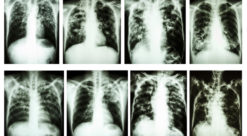
Researchers at NTNU have managed to show exactly how the tuberculosis bacterium kills its host cell by filming the process in detail for the first time. Every year, 1.5 million people die of TB. Watch the clips below.
Certain type of cancer drugs that promote the death of cells can actually be harmful if combined with other treatments that damage our DNA, RNA or proteins, researchers have found.
Sogndal football teams from Vestland county in Norway have now been studied by specialists. Football coaches often consider the players with the greatest passion and grit to be the best.
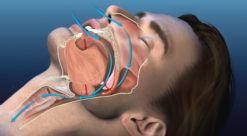
Every fifth Norwegian suffers from the widespread disease obstructive sleep apnea. Several treatment options exist, among them surgery, however results are unpredictable and of variable quality and differ from individual to individual. What determines if the treatment is successful or not? Our scientific research using mathematical airflow models may help the medical doctors to find the answer.
The Norwegian Directorate for Health and Human Affairs recommends more physical activity and less sitting time. But that isn’t the right approach to managing neck and back pain for everyone, according to research from NTNU.
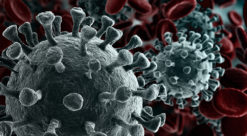
Testing families of four or more people would be an effective way to reduce the spread of the coronavirus infection, according to a data simulation model developed at NTNU. The model has initially been used to determine the best testing strategy for Oslo.
CT screening to detect lung cancer can save lives. The challenge is to find out who should undergo CT scans. A new method more accurately identifies the right individuals in the risk zone.
NTNU researchers recently figured out a whole new method for testing people for the coronavirus. The university is now producing tests on a continuous basis, under the auspices of the Norwegian Directorate of Health. Currently 100 000 tests a day are being manufactured, with production soon likely to be scaled up dramatically.
Road dust can be a big problem in the winter, especially in northern climes where the use of studded tyres is allowed. Researchers are now studying how the type of stone used in asphalt affects the amount and harmfulness of dusty particulate matter that gets kicked up as studded tyres chew into the asphalt.
Children’s health declines the longer they live in refugee camps. Many adults are also struggling, with seven out of ten feeling like they have no future.
Italy’s budget deficit is skyrocketing. Yet people there are not debating the cost of a human life, or whether the shutdown of the country is worth it.
NTNU in Gjøvik has developed a better design for face shields, which are part of the personal protection equipment used by medical professionals. Major production of the new shields – up to 250 per day – is starting on the university’s 3D printers this week.
Restlessness, insomnia, ruminating and aching muscles. Here are one professor’s tips for anyone who is struggling with anxiety and fear due to the coronavirus.
By manipulating the “instruction manuals” that control cell function in our bodies, we will soon be able to combat many diseases, including the new coronavirus outbreak. However, in the worst scenario, such innovations will only benefit the rich.
Developing an effective treatment for Alzheimer’s disease is the long-term goal of a new national research centre in Norway. Nobel laureates Edvard Moser and May-Britt Moser will lead the K. G. Jebsen Centre for Alzheimer’s Disease, aimed at determining how Alzheimer’s disease arises in the brain and its early stages of development.
The Privacy Statement is about how this website collects and uses visitor information. The statement contains information that you are entitled to when collecting information from our website, and general information about how we treat personal data.The legal owner of the website is the processing officer for the processing of personal data. It is voluntary for those who visit the web sites to provide personal information regarding services such as receiving newsletters and using the sharing and tip services. The treatment basis is the consent of the individual, unless otherwise specified.
1. Web analytics and cookies (cookies)
As an important part of the effort to create a user-friendly website, we look at the user pattern of those who visit the site. To analyze the information, we use the Google Analytics analysis tool.Google Analytics uses cookies (small text files that the site stores on the user's computer), which registers the users' IP address and provides information about the individual user's online movements. Examples of what the statistics give us answers to are; how many people visit different pages, how long the visit lasts, what websites users come from and what browsers are used. None of the cookies allow us to link information about your use of the site to you as an individual.The information collected by Google Analytics is stored on Google servers in the U.S.. The information received is subject to the Google Privacy Policy.An IP address is defined as a personal information because it can be traced back to a particular hardware and thus to an individual. We use Google Analytics's tracking code to anonymize the IP address before the information is stored and processed by Google. Thus, the stored IP address can not be used to identify the individual user.
2. Search
If the webpage has search function, it stores information about what keywords users use in Google Analytics. The purpose of the storage is to improve our information service. The search usage pattern is stored in aggregate form. Only the keyword is saved and they can not be linked to other information about the users, such as the IP addresses.
3. Share / Tips service
The "Share with others" feature can be used to forward links to the site by email, or to share the content of social networking. Tips for tips are not logged with us, but only used to add the tips to the community. However, we can not guarantee that the online community does not log this information. All such services should therefore be used wisely. If you use the email feature, we only use the provided email addresses to resend the message without any form of storage.
4. Newsletter
The website can send out newsletters by email if you have registered to receive this. In order for us to be able to send e-mail, you must register an e-mail address. Mailchimp is the data processor for the newsletter. The e-mail address is stored in a separate database, not shared with others and deleted when you unsubscribe. The e-mail address will also be deleted if we receive feedback that it is not active.
5. Registration, form
The website may have a form for registration, contact form or other form. These forms are available to the public to perform the tasks they are supposed to do.Registration form is for visitors to sign up or register.Contact form is for visitors to easily send a message to the website's contact person.We ask for the name of the sender and contact information for this. Personal information we receive is not used for purposes other than responding to the inquiry.The form is sent as email via Mailgun as a third party solution. The entire submission will be stored at Mailgun for 24 hours. Between 24 hours and 30 days, only mailheader is stored before the submission is deleted after 30 days. The reason for this storage is to confirm whether emails are sent from the website and forwarded to the correct recipient.Once the email is received by the recipient, it is up to the recipient to determine the data processing needs of the email.
6. Page and service functionality
Cookies are used in the operation and presentation of data from websites. Such cookies may contain language code information for languages selected by the user. There may be cookies with information supporting the load balancing of the system, ensuring all users the best possible experience. For services that require login or search, cookies can be used to ensure that the service presents data to the right recipient.